Young Japanese woman with golden Reiki light streaming from her hands in a lotus garden under an aurora sky
Reiki

Reiki.
Not wellness. Not a profession. A path.

Mikao Usui didn't leave behind a method for treating illness. He left behind a path. Here you'll find out what Reiki really is, and why I deliberately don't call it a training.

What Reiki really is
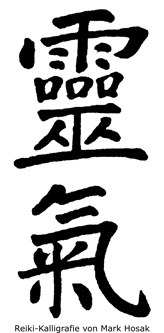
The Reiki characters 霊気 · calligraphy by Dr. Mark Hosak
Reiki · 霊気 · calligraphy by Mark

Spirit and breath.
Soul and power.

Reiki is a Japanese practice of energy work. Written with two characters, 霊気, the word means spirit and breath, soul and power. It refers to the subtle power that flows through everything that lives.

Through the initiation, the connection between you and this power is built. It can flow through the hands, through the breath, through attention. It can turn toward another being: a person, an animal, a place.

What Reiki is not: a religion, a spa treatment, a medical treatment or an esoteric show. The roots of Reiki reach far back behind Usui. Its founder in the modern sense was Mikao Usui, a Japanese practitioner with deep roots in Shingon Buddhism, Tendai Buddhism and Shugendō, the Japanese tradition of mountain asceticism. He had the experience from which Reiki arose in 1922, in the Kurama Mountains north of Kyoto.

Not a trade

The hand on the shoulder
is not the practice.

A carpenter can master his trade without ever building furniture for himself. He has to know the technique. His character, his perception, his inner clarity aren't part of what gets tested. They make the difference between a good carpenter and a mediocre one. But they're not what ends up on the certificate.

With Reiki, it's exactly the other way around.

The hand on the shoulder is not the practice. The hand is only the visible end of it. What really happens, happens in perception.

Do you sense what's going on inside you? Do you sense what's going on in the other person? Do you feel the difference between your own pain and the pain you're picking up through your hands right now? Do you notice when the person in front of you is frozen, and when that begins to release?

These are perceptual abilities. Empathy without losing yourself. Awareness of the subtle layers of what happens between people. A neuroscientist would call it mirror neuron work. A Japanese monk would call it a practice of the extrasensory. Both mean the same thing.

Abilities like these can't be drilled in during a thirty-hour weekend format. They open. Or they don't. And they only open when you commit to the path, not to the technique alone.

A path

It begins
with the initiation.

The initiation is a transmission. It creates the connection. It turns the hand into an antenna. But it isn't the end, it's the beginning. Only then does the real work start: sensing, clearing, deepening. Refining what can't be explained, only experienced.

That is self-mastery: mastering your own perception, your own energy, your own clarity. In Japanese it's simply called 道, michi, the path. I call it the Master Path.

You don't become a master because you have a certificate. You become a master because you walk the path. Long enough. Genuinely enough. Deeply enough.

Mikao Usui's vision

Inner and outer prosperity.
Peace with yourself and the world.

It's written on the memorial stone for Mikao Usui at Saihō-ji temple in Tokyo. I've seen the stone myself, photographed it and translated it.

Usui didn't want Reiki to become a method for treating illness. He wanted people to walk a path: a path to inner and outer well-being, to peace with themselves and the world, to an abundance that doesn't just mean material wealth but wholeness. Helping those in need is part of it. But as the natural fruit of your own path, not as a business model.

As Reiki spread from the 1980s on, laying on hands as an application moved to the foreground in many places, and the meditative and spiritual dimension fell behind. That's a shift in emphasis worth knowing about when you choose a Reiki path.

A deliberate choice of words

Why I deliberately don't call it
a training.

There's a legal reason, and a deeper one.

The legal reason.

A few decades ago, advertising in Germany, where I've worked for most of my life, looked very different. It was common to advertise the treatment of illnesses, even though strictly speaking that was already problematic back then. Nobody checked. At some point a classic trick came up: if I'm not allowed to advertise that I heal, I'll advertise that I train someone who can then heal. That detour is closed today as well. German law now regulates very strictly what may be promised as an effect, and just as strictly what may call itself a training at all.

If you've been searching for Reiki training or Reiki certification, I completely understand. That's what it's called almost everywhere. On Reiki training: levels, paths and what really matters you'll find the map for it: what's behind the three levels, what a path costs, and how to recognize a genuine tradition.

The deeper reason.

What I offer isn't vocational training. It's also not a weekend program with a certificate on Sunday evening. It's a path, and it takes as long as you need to really walk it. Some walk it for years. Some for a lifetime.

The word training carries a certain expectation: you go in, a technique gets passed on to you, you come out and can do it. On the Master Path the movement is a different one. You go in, you open up, and while you walk, something in you wakes up. That's a different movement. And it deserves a different word.

A story I tell often

10,000 dollars, and the day
I understood what had gone wrong.

One of my own masters once told me that if I couldn't pay 10,000 dollars, I wasn't spiritually developed enough to receive the master initiation.

That stayed with me for a long time. Not because the money hurt, but because the logic behind it did.

Spiritual maturity can't be measured in dollars. Anyone who equates money with worthiness has missed something essential. That exact confusion (payment equals worthiness, certificate equals ability, initiation equals maturity) runs through large parts of the Reiki world to this day.

Here's what often happens. Someone receives the master initiation, and for a few weeks there's euphoria. Finally arrived. Finally a master. Then the euphoria fades, and you notice that the problems from before are still there. Inside, you know you're not really far enough along. On the outside, you still say what's on the certificate. The ego keeps that going. Inside, a split opens up.

Many of these people find their way to me later. Some want to say so openly, some don't. That's human, and that's okay. Nobody loses face here. Some would love to continue at an advanced level right away, because they already carry the master title. Others sense at some point that a new beginning is needed, not as a step back but as the start of what wasn't offered back then. For them, the real path begins with Shingon Reiki Level 1.

I offer the path that some of them were never offered.

The Shingon Reiki Master Path

A foundation.
And a path.

You sense that the usual Reiki world isn't enough. Maybe you've already received initiations. Maybe even the master level. And still there's this question: there has to be more. Something's missing. This is where the path begins.

The foundation: Shingon Reiki 1 and 2

Shingon Reiki 1 carries five initiations. Four of them are the traditional Reiki initiations, which connect you with this power for life, so that from now on the power flows through your hands. The fifth is a Buddhist initiation into the power of the Medicine Buddha. You can pass on his spiritual power through your hands just like Reiki.

Shingon Reiki 2 carries two initiations. The first is into the Reiki symbols (Cho Ku Rei, Sei He Ki, Hon Sha Ze Sho Nen) and with them into working with distance contact and mental and emotional clearing. The second is into the traditional healing mantra of the Medicine Buddha. You can use this power together with Reiki as well.

If you find everything you're looking for here, you're just as right as someone who wants to go further. That's your decision, at your point on the path.

The Master Path: 24 months, and still not an end point

The Master Path is laid out over 24 months. That's the time it takes to gather enough practice, enough depth and enough room for experience so that you can keep walking the path on your own afterwards. But 24 months is no promise that a particular development will happen in that time. Otherwise it would be a training again.

At its center are the three mysteries: body, speech and mind. Mudra in the hands, mantra on the lips, visualization in the mind. Not one after the other. All at once.

The content keeps evolving. I keep researching, and every year new insights are added. You don't get a fixed program, but all the Shingon Reiki live events of the 24 months: the foundation is in there, and at the same time the newest things we're working on.

Spirits working through your hands

Month after month you receive an initiation into a Buddhist spirit. Each one has a concrete quality and a concrete way of working. A selection:

And it goes on. This is only a selection.

Kuji Kiri 1 and 2 are included

This opens the foundations of Shingon Mikkyō in a depth that many Reiki paths don't provide for:

Anyone so moved by Fudō Myōō and the transformation of karma that they want to go even deeper can later continue Kuji Kiri up to Level 9 as a Master Path of its own. That isn't a training either. It's an enormous deepening.

Concrete themes from the live events

To give you an idea of what can happen in those 24 months, here's a small selection of live event themes from recent years:

These themes don't repeat in a fixed order. Every year new focal points are added, growing out of my current research and the practice of the community.

Three ways to walk the Master Path

So that it fits your life, the Master Path comes in three versions:

Standard

A membership you can start any time. Online, once a month: initiation, ritual, shared practice. You can pause. The quiet door into the path.

Premium

All Shingon Reiki live events of the 24 months, plus inspiring online meetings between the events. You're in the current of the community, going broader and deeper.

VIP

Premium plus one-to-one time with Mark once a month. And at the end, three days one-to-one in an inspiring place. The most concentrated form of the path.

The live events mostly take place online, because that's what the community wants. When we meet in person, it's sometimes in Germany and sometimes in other inspiring places where life has taken Eileen and me. Online works across continents. We've experienced that often enough. All the details are on Your Path.

The master initiation comes when its time has come

It isn't a graduation. It's a point on a path that keeps going. You receive it because you've walked the path. Not because a date has been reached or an amount has been paid. That makes all the difference.
Why Shingon Reiki
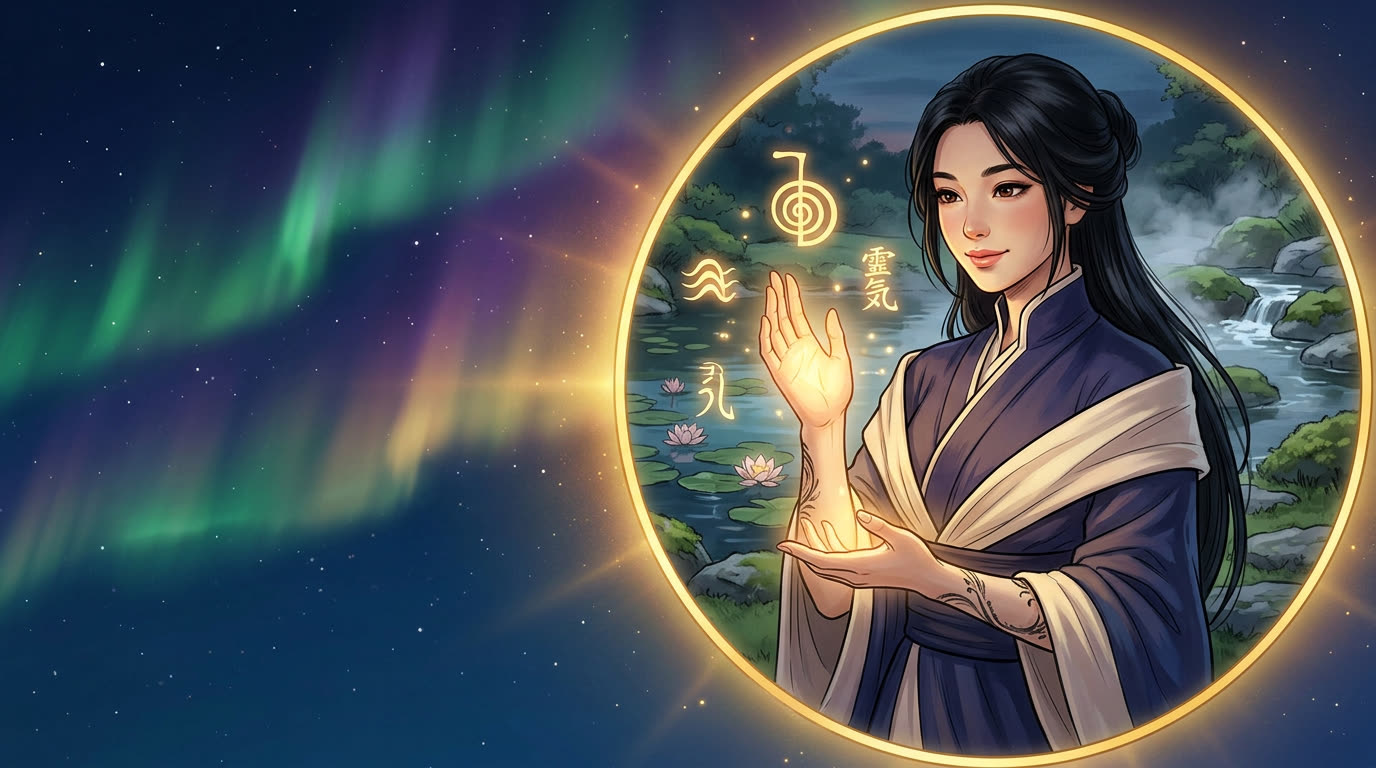
Seven chakras with Siddham calligraphy · Shingon Reiki
Seven chakras with Siddham · Shingon Reiki

The roots
Usui drew from.

Three years of research in Kyoto. Practice with Shingon, Tendai and Zen monks. The 88 temples of the Shikoku pilgrimage on foot. Calligraphy with the Zen monk Hoon Kenmyo in Heidelberg. A doctorate at Heidelberg on the Siddham script (Bonji in Japanese) in Japanese art: the origins of what we know today as the Reiki symbols, in the original sources.

All of this made it clear to me that the tradition carries far more than most accounts of Reiki show. The symbols have a history in the Siddham script, the initiations have sources in esoteric Buddhism, and the practice has roots in Shugendō, Shintō and shamanic Daoism.

Shingon Reiki brings that back. Not as a nostalgic exercise, but as the form in which the practice was originally meant.

Eileen Wiesmann accompanies this path as an equal: as a historian with a focus on the history of religion, and as a Shingon Reiki Master with a special eye for sensitive people, work with animals and crystals.

What opens up

Experiences many practitioners
describe over time.

No promises of healing. Experiences from the practice of people walking the path.

How to begin

The path begins
with Level 1.

The first step

Shingon Reiki Level 1

Two days live online, in English, at the end of which you no longer know what Reiki is from a book, but from your own hands.

  • Five initiations: four into the classic Reiki power, one into the power of the Medicine Buddha
  • The seven techniques from the Japanese tradition that refine your perception layer by layer
  • Sets of hand positions for the morning, the afternoon and the evening

Next dates: see events

See Shingon Reiki Level 1
Not quite ready yet?

Then start with your hands.

A practice from the Japanese tradition: two minutes, breath and hands, nothing required beforehand. You get it as a printable PDF, and after that a note from the tradition now and then. When you take the next step is up to you.

Get the practice

Please note: working with Shingon Reiki offers impulses for self-awareness, mindfulness and personal development. It is not a substitute for medical or therapeutic treatment.

Common questions

FAQ

What is Reiki? ▸
Reiki is a Japanese practice of energy work. The word 霊気 means spirit and breath, soul and power. Through the initiation, the connection between the practitioner and this power is built, and it flows through the hands, through the breath, through attention. Its founder in the modern sense was Mikao Usui (1865–1926), who had the experience from which Reiki arose in 1922 in the Kurama Mountains north of Kyoto.
Is Reiki a religion? ▸
No. Reiki is a practice. It has roots in the spiritual traditions of Japan (Shingon Buddhism, Tendai, Shugendō, shamanic Daoism), but it doesn't require any particular religious affiliation. People of any worldview can practice Reiki.
How much does Reiki training cost? ▸
We don't call it a training. In Shingon Reiki there are Shingon Reiki 1 and 2 as the foundation, and the Master Path over 24 months in three versions (Standard, Premium, VIP). You'll find details on content and prices on the Your Path page.
Can I learn Reiki? ▸
Reiki isn't learned in the classic sense. It's received in the initiation and deepened in your own practice. The door to receiving it is the initiation of Shingon Reiki 1. What opens up after that (perception, empathy, clarity) develops by walking the path, not by completing a program.
How long does the Shingon Reiki Master Path take? ▸
The Master Path is laid out over 24 months. That's the time that allows for enough practice and depth to keep walking the path on your own afterwards. But the 24 months are no promise that a particular development will happen in that time. Otherwise it would be a training again. Some keep walking the path afterwards, some come back to deepen.
Is Reiki dangerous? ▸
Reiki is a gentle, inviting practice that has been passed on for more than a hundred years. As with any serious practice, accompaniment by experienced practitioners is helpful, especially when deeper layers are touched.
Does Reiki help with illness? ▸
Reiki is not a medical treatment and doesn't replace medical care. Practitioners often describe Reiki as supportive of well-being, self-awareness and inner calm. We can't and won't make any specific promises of healing.
What are the Reiki symbols? ▸
In the classic Usui system, four main symbols are passed on: Cho Ku Rei (power), Sei He Ki (correcting habits that cause suffering), Hon Sha Ze Sho Nen (distance Reiki) and Dai Ko Myo (the master symbol). Their roots lie in the Siddham script of Shingon Buddhism. Shingon Reiki deliberately cultivates this connection.
What sets Shingon Reiki apart from other Reiki styles? ▸
The foundation is the same Reiki power. Shingon Reiki also focuses on the roots Usui drew from: esoteric Buddhism (Shingon), Shugendō, Shintō and shamanic Daoism, with Siddham, mantra, mandala, meditation and the Buddhist spirits.
Do I need prior experience for Shingon Reiki 1? ▸
No. You can begin with Shingon Reiki 1 without any prior experience. If you already have Reiki initiations from other lineages, that's welcome too. Many then deliberately begin the path anew with Shingon Reiki 1.
Can I experience Reiki online? ▸
Yes. The live events mostly take place online, and you take part from home. In-person meetings happen in addition, in changing places.
Who was Mikao Usui really? ▸
Mikao Usui was a Japanese practitioner from a samurai family, with deep roots in Shingon Buddhism, Tendai Buddhism and Shugendō. He had his experience in 1922 in the Kurama Mountains.
What does the Master Path mean in practice? ▸
The Master Path is a 24-month path of experience after Shingon Reiki 2. Monthly initiations into Buddhist spirits: the Medicine Buddha, Fudō Myōō, Senju Kannon, Dainichi Nyorai, Jizō and more. Kuji Kiri 1 and 2 are included. Live events on perception, energetic clearing, regression work and protection. Three versions: Standard, Premium, VIP.
Do I get a certificate at the end? ▸
After each initiation you receive a certificate confirming the transmission. But the paper isn't what matters. What matters is deepening what you carry inside you. The master initiation comes when its time has come, because you've walked the path, not because a date has been reached.
Going deeper

Read more about Reiki.

Reiki holds many worlds: history, symbols, practice, roots. These articles take you further into each of them.

Levels, paths and cost
The map: what's behind the levels and what really matters.
Mikao Usui, the founder
A biography beyond the legends.
The five life principles (Gokai)
Usui's five principles for every day.
The Reiki symbols
What's really behind the four symbols.
Cho Ku Rei
The symbol of focused energy.
Sei He Ki
Correcting habits that cause suffering.
Hon Sha Ze Sho Nen
The distance symbol across space and time.
Dai Ko Myo
The great light: the master level.
The Kurama Mountains
Where Usui had the experience from which Reiki arose.
The Medicine Buddha
Companion in Shingon Reiki 1 and 2.
Fudō Myōō
The Immovable One: protection and clarity.
Kuji Kiri
The nine syllables, part of the Master Path.
Shingon Buddhism
The esoteric tradition behind Reiki.
🏯
Dr. Mark Hosak
PhD in Japanese Studies · researcher and practitioner of the Shingon tradition · founder of Shingon Reiki

Mark Hosak earned his PhD at Heidelberg University on Siddham (Bonji in Japanese) in Japanese art, did three years of research at Kyoto University, and completed the Shikoku pilgrimage with all 88 temples. He is the author of the bestseller The Big Book of Reiki Symbols and has been transmitting Shingon Reiki for more than 25 years.

More about Mark → Books →