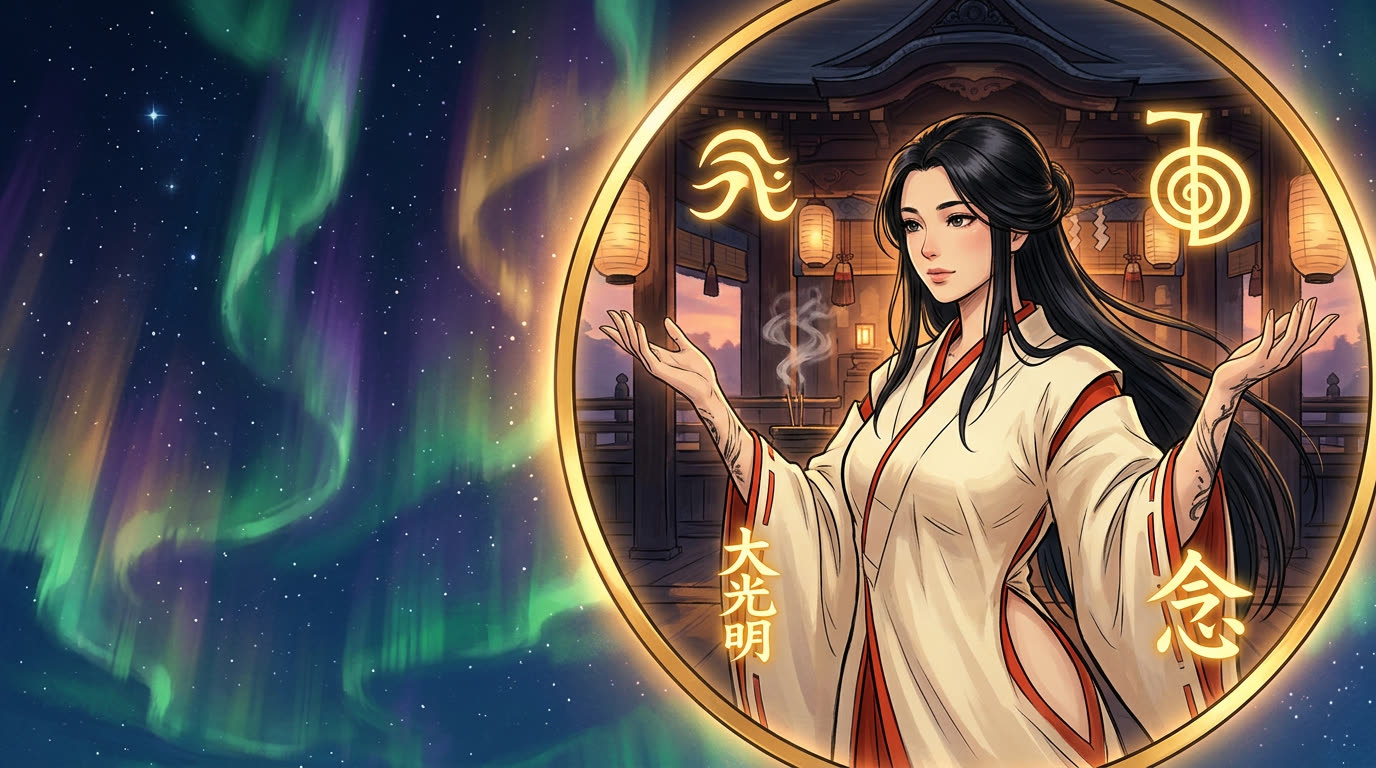
The symbols behind Reiki. And what they really are.
Reiki symbols are not abstract marks. They are keys to a living tradition —
rooted in the Siddham script, in the esoteric calligraphy of Japan,
and in a practice that has been passed on for more than a thousand years.
The four Reiki symbols
Four keys. Four gates into the practice.
Each symbol carries its own quality. In Shingon Reiki they are not only tools —
they are gates to specific Buddhas and Bodhisattvas of the esoteric tradition.
Cho Ku Rei
直霊 · Power Symbol
Sei He Ki
性平癒 · Mental Symbol
Hon Sha Ze Sho Nen
本者是正念 · Distance Symbol
Dai Ko Myo
大光明 · Master Symbol
Origin and meaning
Seven chakras with Siddham syllables · calligraphy
Signs that carry force.
Reiki symbols are ritual signs. They are activated in the Reiki initiation and serve as keys to specific qualities of force. Their roots lie in the Siddham script of esoteric Buddhism, where every sign embodies a Buddha or a Bodhisattva. In the Western Reiki world they were treated for decades as abstract tools. Their true origin stayed in the dark.
That is astonishing. Because the symbols carry a story far larger than Reiki. They connect to the traditions of esoteric Buddhism, Shugendo, Shinto and shamanic Daoism. In temples like Kurama-dera near Kyoto — where Mikao Usui had his decisive experience — these signs are still alive today.
Dr. Mark Hosak researched exactly this connection in his doctoral thesis at Heidelberg University. Three years of fieldwork in Japanese temples. Translation of Japanese and Chinese source texts. The result: the Reiki symbols are not modern inventions. They are echoes of a ritual practice carried forward in the temples of Japan since the 9th century.
In Shingon Reiki the symbols are not only used. They are practiced in their full depth — with mantra, mudra and Siddham. The way they once arose in the temples. Not as a tool. As a living connection.
Going deeper
The world of the Reiki symbols in single articles.
Companions on the path — on the force of the symbols.
Individual experience.
Each voice is a personal account. Results can vary and depend on prior knowledge,
openness, life circumstances, and many other factors.
Reiki and spiritual practice do not replace medical or psychological treatment.
"I had already strongly suspected it — and experienced it on my path to Reiki master —
and I do work with the force of the Reiki symbols. Even so, I was astonished
that when practicing the art of calligraphy the energy flow becomes tangible
through the brush — and is even visible in the result on the paper."
Benjamin, Freiburg
Companion · symbol & calligraphy practice
"What I use most are the symbols. They are a really cool enrichment
for my work with Reiki."
In The Big Book of Reiki Symbols you will find the full story — from the temples of Japan into your hands.
And on the Shingon Reiki path you experience what no book can hand over: the living initiation.
For complete author credits, see the book cover and publisher page.
Frequently asked
FAQ
What is Cho Ku Rei?
▸
Cho Ku Rei is the Reiki power symbol — usually the first symbol a Reiki practitioner receives. It focuses and amplifies Reiki force in a given moment or place. Its name and form trace back to the calligraphic and Siddham traditions of Japan.
What is Sei He Ki?
▸
Sei He Ki is the Reiki mental and emotional symbol. It is used to harmonise mind and feeling and to release patterns. In Shingon Reiki it is also linked to the practice of clearing inner turbulence so that deeper Buddhist forces can flow.
What is Hon Sha Ze Sho Nen?
▸
Hon Sha Ze Sho Nen is the Reiki distance symbol. It allows Reiki to be transmitted across space and time — to other people, to past situations, to future events. Its name carries the meaning "the true person, here, in right mindfulness."
What is Dai Ko Myo?
▸
Dai Ko Myo is the Reiki master symbol — "great bright light." It is given at the master level and carries the deepest light of the lineage. In Shingon Reiki it is connected to Dainichi Nyorai, the cosmic Buddha at the heart of esoteric Buddhism.
Where do the Reiki symbols come from?
▸
Sei He Ki goes directly back to the Siddham Hrīḥ, rooted in the esoteric calligraphy of Shingon Buddhism. They are not modern inventions. They carry centuries of ritual practice from the traditions of esoteric Buddhism, Shugendo, Shinto and shamanic Daoism.
What is the difference between Reiki symbols and Siddham?
▸
Siddham is the sacred script of Shingon Buddhism — every sign embodies a Buddha or Bodhisattva. Sei He Ki goes directly back to the Siddham Hrīḥ, and the Hon Sha Ze Sho Nen holds five Siddham as the blueprint of the five elements. In Shingon Reiki the original connection to the Siddham is restored.
Can Reiki symbols be used without initiation?
▸
The symbols only unfold their full force through initiation. Without initiation they remain ink on paper. The initiation activates the energetic connection to the symbol and its source — that is a living transmission that no book can hand over on its own.
How many Reiki symbols are there?
▸
In the classical Usui system four main symbols are transmitted: Cho Ku Rei (power), Sei He Ki (harmony), Hon Sha Ze Sho Nen (distance) and Dai Ko Myo (master). In Shingon Reiki further Siddham syllables are added — the original source the simplified symbols come from.
What does the Reiki distance symbol do?
▸
Hon Sha Ze Sho Nen, the distance symbol, dissolves the illusion of separation in space and time. Practitioners use it to send Reiki to people, situations and moments that are not physically present — to the past, to the future, across continents. It is the symbol that opens the room of connection.
How are Reiki symbols actually used?
▸
A practitioner visualises the symbol, draws it in the air or on the body, and speaks or whispers its mantra. The combination of visualisation, gesture and sound activates the energy carried in the symbol. In Shingon Reiki this is rooted in the older Japanese tradition of mudra, mantra and meditative image — the threefold practice known as San-mitsu.
How do you draw the Reiki symbols correctly?
▸
The stroke order follows the Japanese calligraphy tradition. In Shingon Reiki we treat the drawing itself as ritual practice: each stroke carries a breath, a mantra, an inner posture. The symbol is not just drawn — it is woken.
Which symbols belong to Reiki level 2?
▸
At level 2 three symbols are transmitted: Cho Ku Rei, Sei He Ki and Hon Sha Ze Sho Nen. With them, distance work opens, deeper pattern-clearing becomes available, and the energy becomes more articulate. Dai Ko Myo follows at master level.
Are Reiki symbols safe to use?
▸
Yes. The symbols themselves are protective and grounding in their origin. They were used in temples for clarity, harmonisation and inner cultivation long before they were adapted into Reiki. A grounded introduction by an experienced teacher remains the wise way to enter the practice.
Go deeper
Read on about the symbols.
Each symbol carries its own story and its own practice. Here are the pieces that go deeper.
Doctorate in Japanology · researcher and practitioner of the Shingon tradition · Founder of Shingon Reiki
Mark Hosak earned his doctorate at Heidelberg University on the origins of Reiki and Kuji Kiri, practiced for three years in the temples of Kyoto and walked the full Shikoku pilgrimage of all 88 temples on foot. He is the author of the international bestseller The Big Book of Reiki Symbols and has been carrying Shingon Reiki forward for more than 25 years.