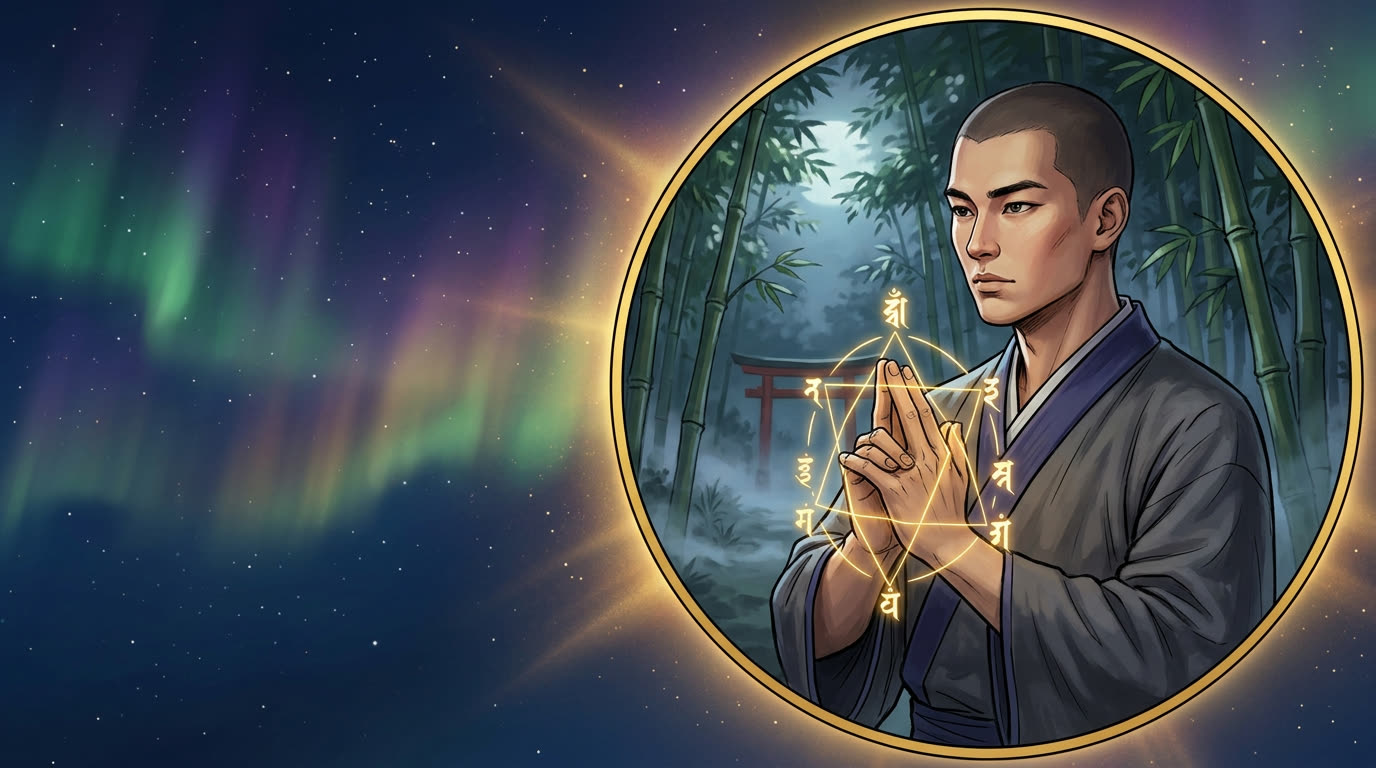
九字切り · Kuji Kiri
臨・兵・闘・者・皆・陣・列・在・前

You have seen it.
Now meet what it actually is.

The hand signs surface again and again in modern Japanese pop culture — and they point at something real. But what you have seen on screen is the shadow of a practice whose depth almost no one suspects.

What Kuji Kiri actually is

Most who think they know it
have barely met it.

Mudra Rin · the first of the nine seals of Kuji Kiri
Rin · the first seal
The Core

Kuji Kiri is not a technique. It is a practice carried within the Shingon tradition — more than a thousand years old, transmitted directly, from initiate to initiate. What is shown in films, shows and short clips is the outer image of an inner reality that stays closed without initiation.

The nine seals at work

Rin · Pyō · Tō · Sha · Kai · Jin · Retsu · Zai · Zen. Nine mudras. Nine mantras. Nine qualities. In combination they act like a deep energetic clearing — channelled through Fudo Myoo, the immovable king of light, who cuts through everything that has lodged itself in.


That is the entry. The first stages. What opens with each further initiation is hard to put into words — because it is direct experience, not description.

Where it comes from

Kuji Kiri has roots in shamanic Daoism, in Shugendo, in Shinto, and in the esoteric Buddhism of Japan (Shingon) — drawn from the same source as Shingon Reiki. It is not a ninjutsu trick or a screen element you can copy from a video. It is a living lineage, passed from master to practitioners through direct initiation.


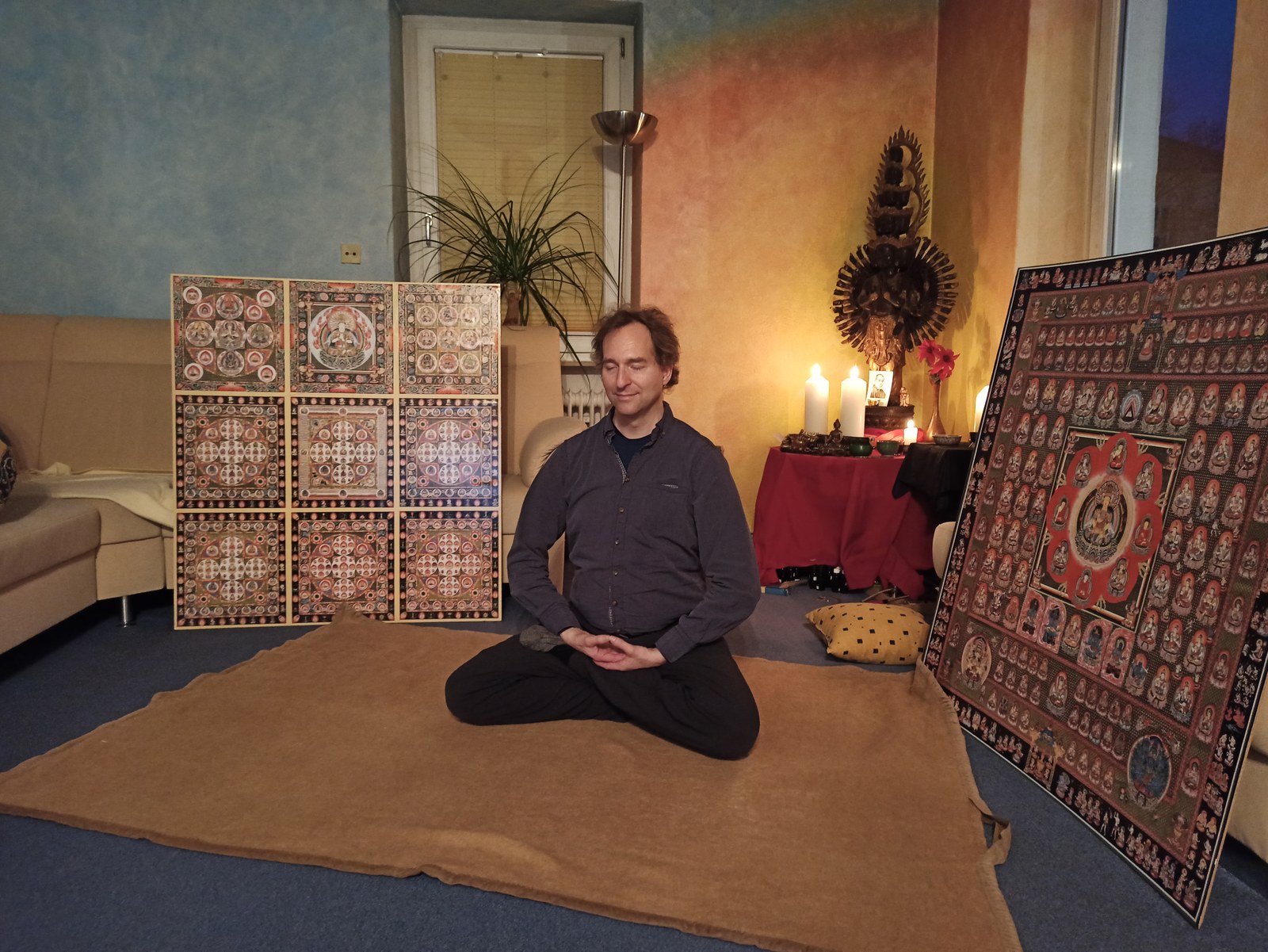
Mark carries this lineage. As a researcher and practitioner of the Shingon tradition, as the successor in a ninjutsu line, as someone who lived three years inside the temples of Kyoto.

Dr. Mark Hosak in meditation practice in front of a thangka
Mark Hosak · meditation in front of the thangka
Rin
Hyo
To
Sha
Kai
Jin
Retsu
Zai
Zen
The Master Path

Nine stages —
one complete journey.

The Kuji Kiri Master Path moves through all nine seals — from the first initiation to the full practice. Each stage builds on the one before. Each opens what the previous one prepared.

Stage 1 · The Foundations

The foundations of Kuji Kiri are the foundations of Shingon Buddhism: Susokukan, Gachirinkan, and Ajikan — three meditation practices that quiet body, mind, and soul, and open the heart for awakening. Together with the Goshinbo — protection across the three layers of karma — and the Hūmjikan, to release inner anger and rage. These are the conditions for letting the strong purifying force of Fudo Myoo flow through you. Initiations into the spirits who work here: Dainichi Nyorai, Senju Kannon, and Kongosatta.

Date to be announced · Register your interest
Stage 2 · Fudo Myoo and the Ritual

The three mysteries of Fudo Myoo — mantra, mudra, Siddham. Together with Kanjikan and the Kuji Kiri ritual with the nine signs and the cutting of the grid. The sword mudra, and the initiation into the force of the immovable king of light.

Date to be announced · Register your interest
Stage 3 · The Nine Mudras · Kuji-in

Initiation into the nine mudras — each mudra carries its own force and its own meditation to unfold it. From the refinement of perception to the art of becoming unseen. The highlight: the full Kuji Kiri ritual with the nine mudras — Kuji-in in its original form.

Stage 4 · Sha

The contents of this and all further stages are transmitted directly within the initiation.

Prerequisite: stages 1–3 completed
Stage 5 · Kai

Direct transmission within the initiation.

Prerequisite: stages 1–4 completed
Stage 6 · Jin

Direct transmission within the initiation.

Next date: 18–19 July 2026 · bilingual DE/EN
Stage 7 · Retsu

Direct transmission within the initiation.

Next date: 17–18 October 2026 · bilingual DE/EN
Stage 8 · Zai

Direct transmission within the initiation.

Date on request
Stage 9 · Zen · The Completion

All nine seals in their complete combination. The completion of the Master Path. What waits here resists description — it has to be lived.

Date on request
Kuji Kiri and Shingon Reiki

Two faces
of the same source.

Mudra Sha · the fourth of the nine seals of Kuji Kiri
Sha · the fourth seal

Kuji Kiri and Shingon Reiki come from the same tradition. They belong together — and they amplify each other.

What Shingon Reiki means for Kuji Kiri

The initiations of Shingon Reiki open the energetic ground on which Kuji Kiri acts. Those who practise Shingon Reiki feel the nine seals at a different level than someone without this foundation. The force flows deeper, clearer, more precise.

What Kuji Kiri means for Shingon Reiki

Kuji Kiri gives Shingon Reiki another dimension of precision. The clearing through Fudo Myoo, the work with the nine qualities — this completes the Buddhist initiation practice in a way you feel in the body the moment you do it.

Voices from the practice

Companions on the path —
on the depth of the tradition.

Individual experience. Each voice is a personal account. Results can vary and depend on prior practice, openness, life circumstances and many other factors. Reiki and spiritual practice are not a substitute for medical or psychological treatment.

"I have been in spiritual practice with Mark for about five years now: Buddhist meditations from the Japanese Shingon school, Qigong, Tai Chi, the Japanese martial art Ninjutsu, calligraphy — a depth I have not found anywhere else."

Meikel G.
Companion · Shingon, Ninjutsu & Calligraphy

"A grounded path of depth — Reiki, shamanism and authentic Shingon Buddhism, all the way through to the inner treasures of wisdom. I have not seen anything like it in this form anywhere else."

Markus B.
Companion · Paths of deepening
Read more voices from the practice →
Step into initiation

The nine seals are waiting.
Begin with stage 1.

Sign up and receive everything you need to know — what Kuji Kiri actually is, how the Master Path unfolds, and when the next initiations take place.

Sign up here — Brevo form

[Brevo opt-in form · list: Kuji Kiri EN]

No spam. Only meaningful messages on Kuji Kiri and Shingon Reiki.

Frequent questions

FAQ

What is Kuji Kiri?
Kuji Kiri (九字切り) means "cutting the nine syllables" and is a ritual practice drawn from the traditions of Shugendo, esoteric Buddhism (Shingon), Shinto, shamanic Daoism, and ninjutsu. It is also known as Kuji-in — the nine seals. The practice combines nine hand signs (mudras), mantras, and visualisations that align body, mind, and energy.
Is Kuji Kiri dangerous?
No. Kuji Kiri is a meditative and energetic practice that has been carried for centuries by monks, yamabushi, and martial artists. As with any serious practice, a grounded introduction by an experienced practitioner matters.
Can I practise Kuji Kiri without Reiki?
Yes. Kuji Kiri is its own tradition and older than the modern Reiki system. You can practise Kuji Kiri on its own — and many people experience it as a powerful complement to whatever practice they already carry.
What does Kuji Kiri have to do with the ninja?
The ninja (shinobi) practised Kuji Kiri as part of their spiritual and physical preparation. It was never a fantasy device but the lived practice of the yamabushi and mountain ascetics, whose knowledge flowed into the ninjutsu tradition. Dr. Mark Hosak is a ninjutsu grandmaster and the successor of Taguchi Sensei.
Why do so many people recognise Kuji Kiri today?
Many recognise the nine hand signs from Japanese popular culture. What is shown there as fiction rests on real practice — documented in historical source texts that Dr. Mark Hosak has translated from the original Japanese and Chinese.