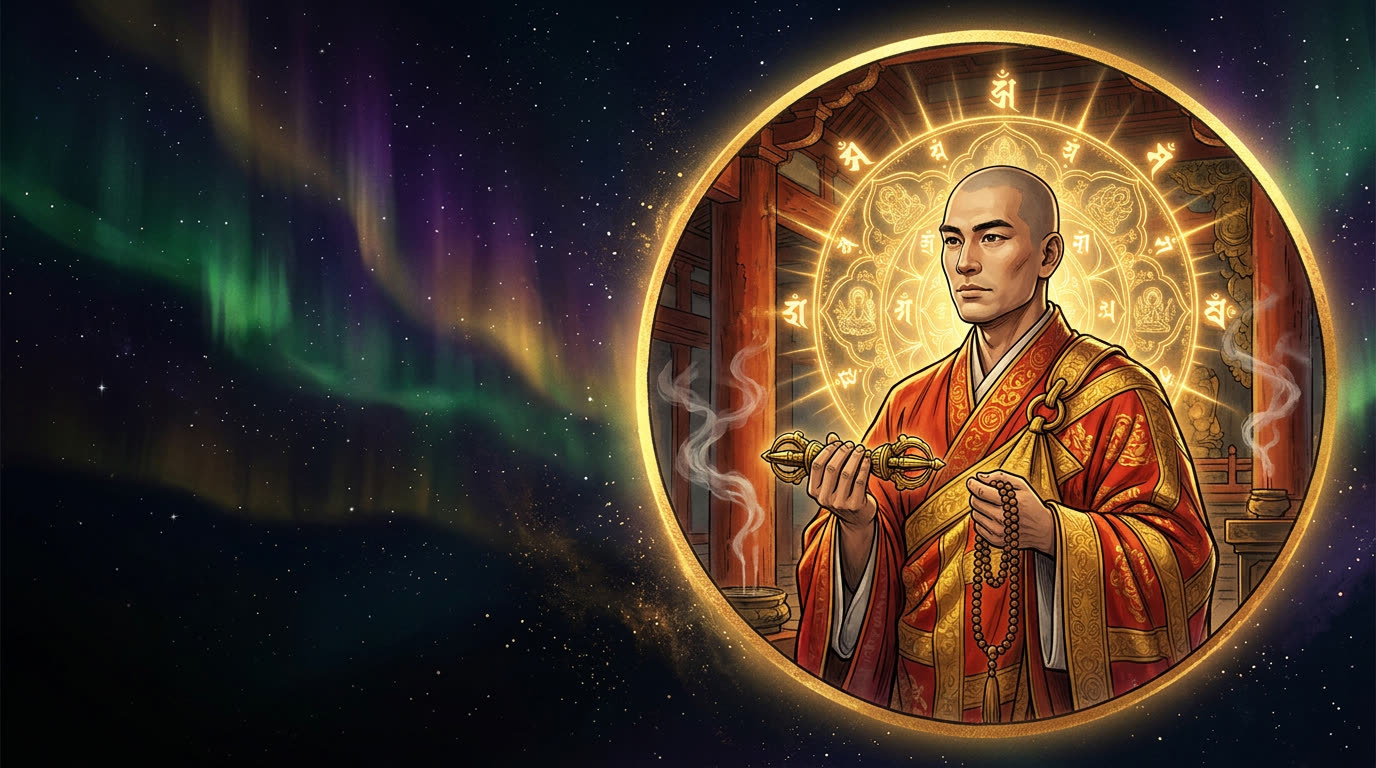
Shingon means "true word." It is the esoteric school of Buddhism in Japan —
and the tradition the deepest roots of Reiki come from.
A path that is not explained. It is entered. It is lived.
The source
Konpon Daitō · the great red pagoda on Mount Kōyasan
Don't believe. Experience.
Shingon Buddhism (真言宗) is a school of esoteric Mahayana Buddhism founded in 9th-century Japan by Kūkai (Kōbō Daishi) after his transmission in Tang-dynasty China. At its centre stands one radical idea: enlightenment is not the result of many lifetimes. It is possible in this very life. Through direct experience. Through the Three Mysteries — Mantra (sound), Mudra (gesture), Mandala (visualisation).
At the heart of the Shingon tradition stands Dainichi Nyorai — the cosmic Buddha, all-encompassing awareness. Everything that exists is his body. Every sound is his voice. Every thought is his mind. The two great Mandalas — the Taizōkai (Womb Realm) and the Kongōkai (Diamond Realm) — are the maps of this reality.
Kūkai brought this tradition back to Japan in the year 806. On Mount Kōya (Kōyasan) he founded the centre that is still alive today — more than 1200 years of unbroken transmission. From master to practitioner. From initiation to initiation. This is not a concept. This is how esoteric knowledge stays alive.
The connection to Reiki is no coincidence. Mikao Usui knew these traditions — Shingon Buddhism, but also Tendai, Shugendō and shamanic Daoism. The Reiki symbols trace back to the Siddham script, which is still the sacred script of ritual practice in Shingon today. In Shingon Reiki this connection is not only acknowledged. It is lived.
Going deeper
Shingon Buddhism in single articles.
Each article is a doorway into a tradition that has been alive for more than 1200 years.
Goma fire ritual with Mark and Eileen · living Shingon practice
Individual experience.
Every voice is a personal account. Results can vary and depend on prior practice,
openness, life circumstances and many other factors. Reiki and spiritual practice
do not replace medical or psychological treatment.
"The path with Dr. Mark Hosak is a very effective way to discover the wisdom of
Buddhism and bring it into daily life. Family or friends — everyone is grateful for
the experiences I get to share from the Shingon Institute."
René S.
Practitioner · Buddhism & everyday life
"A grounded, deeply unique path into Reiki, shamanism and authentic Shingon
Buddhism — all the way to the inner treasures of wisdom."
The Shingon path is not a theoretical one. It comes alive in practice —
through initiations, through meditation, through the direct encounter with Buddhas and Bodhisattvas.
In Shingon Reiki this path is open to everyone who answers the call.
Shingon (真言, "true word") is a school of esoteric Mahayana Buddhism brought to Japan in the 9th century by Kūkai (Kōbō Daishi) after his transmission in Tang-dynasty China. The Shingon tradition works with the Three Mysteries — Mantra (sound), Mudra (gesture) and Mandala (visualisation) — as direct paths to the realisation of enlightenment in this very lifetime.
What is the connection between Shingon Buddhism and Reiki?▸
Reiki has its roots in the esoteric traditions of Japan, of which Shingon Buddhism is the largest. Mikao Usui knew these traditions from his own practice. The Reiki symbols trace back to the Siddham script, which is still the ritual script of Shingon today. In Shingon Reiki this original connection is restored and woven back into the practice.
Who was Kūkai?▸
Kūkai (774–835), posthumously named Kōbō Daishi ("Great Master who spread the Dharma"), was the founder of the Shingon school in Japan. In the 9th century he travelled to China, received the full transmission of esoteric Buddhism, and brought it back to Japan. On Mount Kōya (Kōyasan) he established the centre of the Shingon tradition — still alive after more than 1200 years.
What is Mikkyō?▸
Mikkyō (密教, "secret teaching") is the Japanese term for esoteric Buddhism. Unlike exoteric schools that approach awakening through study and gradual cultivation, Mikkyō works with ritual, mantra, mudra and mandala as direct, embodied means. Shingon and Tendai are the two great Mikkyō schools of Japan.
What are the Three Mysteries (Sanmitsu)?▸
The Three Mysteries — Sanmitsu (三密) — are body, speech and mind, expressed through Mudra, Mantra and Mandala. In Shingon practice they are not techniques on top of life. They are the way the practitioner aligns body, speech and mind with the body, speech and mind of the Buddha. Direct. Embodied. In this life.
What is the Goma fire ritual?▸
The Goma (護摩) is the Shingon fire ritual, performed in front of the Honzon — the central deity of the rite, often Fudō Myōō. Wooden sticks carrying intentions are offered to the flames. Body, speech and mind move as one. The Goma is one of the most powerful and most public rituals of Shingon and is still practised every day on Mount Kōyasan.
Is Mark Hosak a Shingon monk?▸
Dr. Mark Hosak is a researcher and practitioner of the Shingon tradition. He earned his PhD in Japanese Studies at Heidelberg University on the Siddham script in Japanese art and ritual. He spent three years inside the temples of Kyoto, walked the Shikoku 88-temple pilgrimage on foot, and has been transmitting the Shingon Reiki path for over 25 years.
Go deeper
Read on inside the tradition.
The world of Shingon is wide — figures, practices, mountains, rituals. Here are the pieces that walk in further.
PhD in Japanese Studies · researcher and practitioner of the Shingon tradition · founder of Shingon Reiki
Mark Hosak earned his PhD at Heidelberg University on the origins of Reiki and Kuji Kiri, practised for three years inside the temples of Kyoto, and completed the Shikoku 88-temple pilgrimage on foot. He is the author of the bestseller The Big Book of Reiki Symbols and has been transmitting Shingon Reiki for over 25 years.