In a Zen monastery in Kyoto a monk sits before an empty sheet of washi paper. He breathes. Long. Then he raises the brush, dips it in the ink and sets it down. A single stroke — and the sign stands. No correction possible. No deleting, no rewriting. What is written is written. And in this moment, all of it lies: breath, posture, mind, years of practice — condensed into a single brushstroke.
That is no writing exercise. That is meditation in motion. In Japan this practice is called Shodō 書道 — the way of writing. And in the Shingon tradition it goes one step further: here calligraphy becomes ritual. Through meditative, contemplative writing, forces are transferred into the signs — and that is the foundation of what we know today as the Reiki symbols.
Shodō — the way of writing 書道
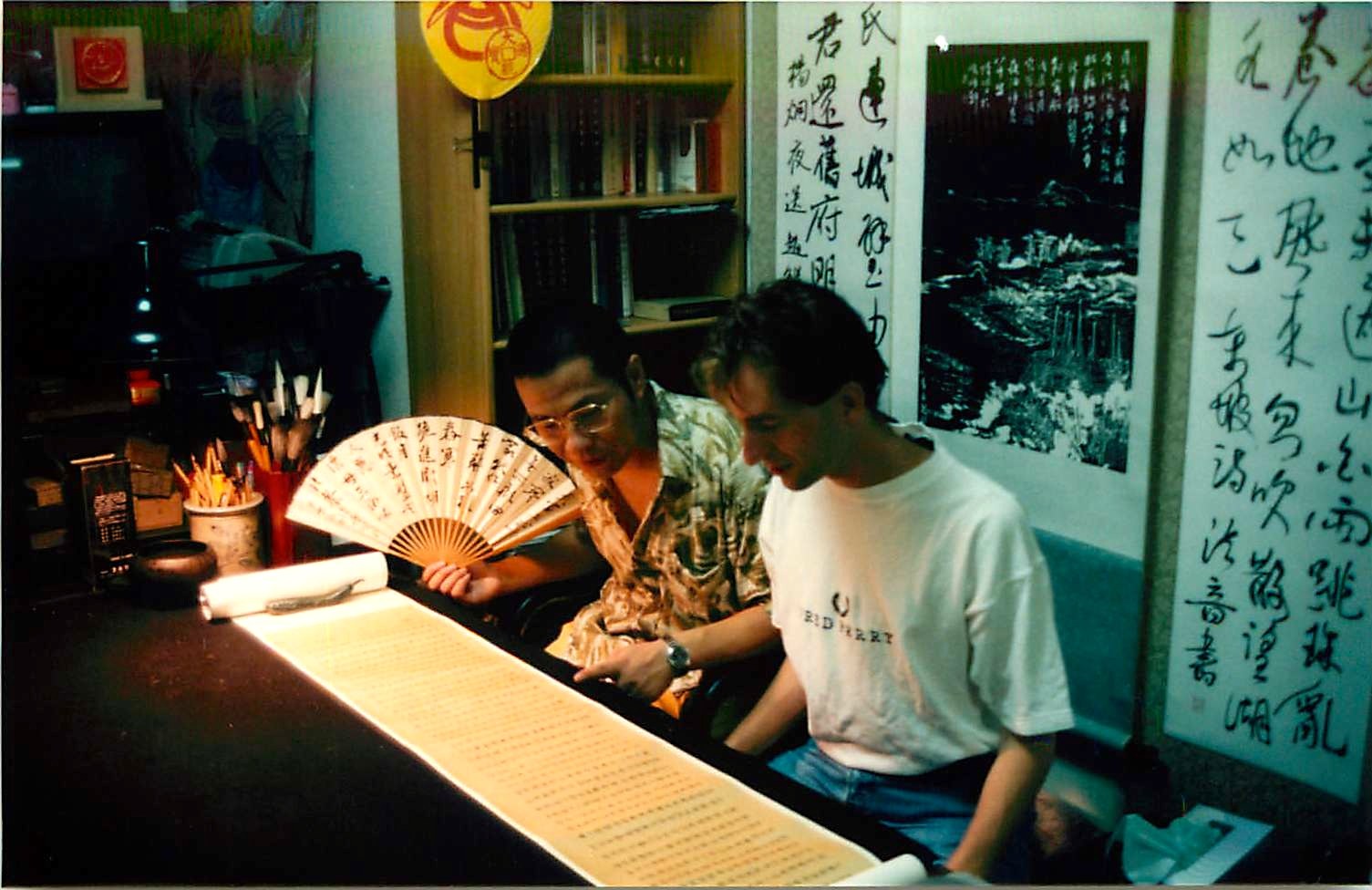
Mark Hosak studied Japanese and Chinese calligraphy with a Zen monk — during his research years in Japan. What he experienced there was not a technique. It was a posture. The monk did not say: "Write this sign." He said: "Become this sign." The difference sounds subtle. But it changes everything.
Because in the Japanese tradition the state of the writer in the moment of writing cannot be separated from the written sign. The one who writes in anger writes anger. The one who writes in deep stillness writes stillness. The brushstroke does not lie. It shows the inner state — unmasked, immediate.
Calligraphy as ritual in Shingon Buddhism 修法
In Shingon Buddhism calligraphy has an additional dimension: it becomes ritual. When a monk writes a Siddham — for example the Siddham A on a talisman — this does not happen as an artistic act. It happens within a ritual frame: with mudra, mantra and visualisation. All three secrets are active while the brush glides over the paper.
That means: the force is not depicted in the sign. It is contained in the sign. The talisman does not work because a particular sign stands on it — it works because the Sanmitsu practice in the moment of writing has transferred the cosmic force into the sign. That is not symbolism. That is ritual reality.
The Reiki symbols as calligraphy 靈符
And here the circle closes back to Reiki. The Reiki symbols — Cho Ku Rei, Sei He Ki, Hon Sha Ze Sho Nen, Dai Ko Myo — are not abstract logos. They are calligraphic signs that come from the Japanese script tradition. Some have roots in Shintō, others in esoteric Buddhism, still others in Daoism. But all work according to the same principle: force is transmitted through writing.
In Western Reiki this understanding has largely been lost. The symbols are regarded as images one draws in the air — like gestures. But in the Japanese tradition, drawing a symbol is an act of writing. And writing — in the context of Shodō and Shingon — is always an act of transmission.
When you draw a symbol in Shingon Reiki, you do not draw it as an image. You write it as calligraphy — with intention, with the breath, with the awareness that the stroke carries the energy. The difference is not in the form. It lies in the state of the one who writes.
Mark Hosak's doctoral thesis "Die Siddham in der japanischen Kunst — Rituale der Heilung" (The Siddham in Japanese Art — Rituals of Healing) examines exactly this connection: how written signs become carriers of spiritual force in the Japanese tradition. The book documents how Siddham characters were written in temples, embedded in ritual and used as talismans — over a period of more than 1200 years. The Reiki symbols are a late chapter in this long story.

Ofuda — talismans with force 御札
In Japanese temples and shrines you can obtain Ofuda 御札 — talismans of paper or wood on which a monk or priestess has written sacred signs. These Ofuda are placed at home — for protection, for good fortune, for spiritual connection. In Shingon temples many Ofuda carry Siddham characters — written in a ritual calligraphy that is centuries old.
An Ofuda does not work like a logo on a product. It is not a label with a spiritual inscription. It is an object into which force was transferred through the ritual writing. The same text, printed on a laser printer, would not have this force. Because the act is missing — the breath, the mudra, the mantra, the concentration. The act of writing is the ritual.
Calligraphy and Reiki practice 実践
In Shingon Reiki, calligraphy is offered as an extended practice. Not as a beautiful-handwriting exercise — as a meditative deepening. Those who write the Reiki symbols with brush and ink experience something that is not possible when drawing in the air: the resistance of the paper, the flow of the ink, the necessity of setting every stroke consciously. There is no undo button. What stands, stands.
This irreversibility is a spiritual principle. It demands presence. Whoever thinks of the next stroke while setting the current one loses the connection. The result is seen at once — in the brushstroke. The ink knows no self-deception.
On the spiritual journeys to Japan that Mark and Eileen offer, calligraphy practice in a temple is a fixed part. To write a Siddham character with ink under the guidance of a monk — in the stillness of an 800-year-old temple, on paper that smells of wood and incense — changes the understanding of what a sign can be.
Encounter calligraphy in Japan
Spiritual calligraphy in a Japanese temple — part of the spiritual journeys to Japan with Mark and Eileen.
Spiritual journeys to Japan The Reiki symbols