
Signs that are not words
The first time someone sees a Siddham, they may think of an exotic written character. Curving lines, foreign and elegant. Maybe they have seen something like it on a temple bell, on an old hanging scroll, or on the gravestone of a Japanese monk.
But a Siddham is not a letter. It is a sound made visible. In Japanese esoteric Buddhism — 密教 Mikkyō — every Siddham is a seed syllable: a condensed sound that carries a specific spiritual force. A Buddha. A bodhisattva. A guardian deity.
Japanese has two terms for this. 悉曇 Shittan refers to the writing system — the way Sanskrit texts are written. 梵字 Bonji refers to the same character when it is used in meditation and ritual. The script becomes a ritual tool.
Siddham are not decoration. They are seed syllables — condensed sounds that serve as a bridge between the practitioner and a specific spiritual force. You do not write them to read something. You write them to call something.
Where the Siddham come from
The Siddham come from Brahmanism in India. And the order matters here: long before the Siddham were used to write down the Sanskrit language, they were already ritual signs. They were used to call spiritual beings — gods, guardian spirits, cosmic forces. Each sign was a sound, and each sound was a bridge. Only over the centuries did this also become a script in which hymns, prayers and ritual texts could be recorded. But the ritual function was the origin — not the other way around.
In India, many writing systems developed further over the centuries. The Siddham, however, were carried from the 7th century onward along the Silk Road and the sea routes to China, together with the sūtras and ritual texts of esoteric Buddhism.
In China, monks began to write the Siddham not with the Indian wooden brush, but with the Chinese calligraphy brush. The form changed slightly — but the ritual core remained. When the Siddham were then transmitted in great quantity to Japan in the 9th century, something remarkable happened: they were not changed further or modernised. Japan preserved the Siddham in a form closer to the original than anything that survived in India itself.
"In Japan, then, we have with the Siddham an original script handed down from ancient times, which originally comes from Brahmanism."
— Dr. Mark Hosak, Reiki in der therapeutischen Praxis (Reiki in Therapeutic Practice)It was Kūkai — 空海, the founder of Shingon Buddhism in Japan — who brought this tradition from China in the year 806. Together with the two great mandalas, the ritual texts and the initiation lineages, he also brought the Siddham practice: the contemplative writing, visualising and intoning of the sacred signs.

What a seed syllable is
In esoteric Buddhism, a Siddham is more than a graphic sign. Every syllable — A, Hrīḥ, Vaṃ, Bhaḥ — stands for one or more Buddhas, bodhisattvas or guardian deities. The force of these beings appears in the context of ritual when the Siddham is written, visualised and intoned correctly.
You can think of it like this: the seed syllable is like a seed. The whole spiritual force of a being is condensed within it — just as the entire tree is already contained in a seed. Through ritual practice, this seed is brought to germinate.
This is not a metaphor. In the Shingon tradition it is lived practice. Monks meditate on a single Siddham, sometimes for years. The most famous of these meditations is Ajikan 阿字観 — the contemplation of the syllable A, the seed syllable of the cosmic Buddha Dainichi Nyorai.
In Shingon, the syllable A is regarded as the primal sound — the beginning of all sounds, all mantras, all language. In Ajikan, the practitioner sits before a calligraphy of the syllable A, contemplates it, breathes with it, lets it dissolve in the mind. It is one of the deepest forms of meditation in esoteric Buddhism.
Six seed syllables and their forces
The overview below shows six central Siddham of Shingon Buddhism. Each is connected with a specific Buddha or bodhisattva and carries its own spiritual quality. In practice they are used singly or in combination — written, visualised and spoken.
大日如来
The cosmic Sun Buddha
阿弥陀如来
Buddha of boundless light
薬師如来
Buddha of the healing force
不動明王
The unshakeable wisdom king
観音
Bodhisattva of compassion
水
Purification and flow
The circles are placeholders. The Japanese Siddham (Bonji 梵字) will be inserted here as images — the calligraphic forms preserved in the Shingon tradition since the 9th century.
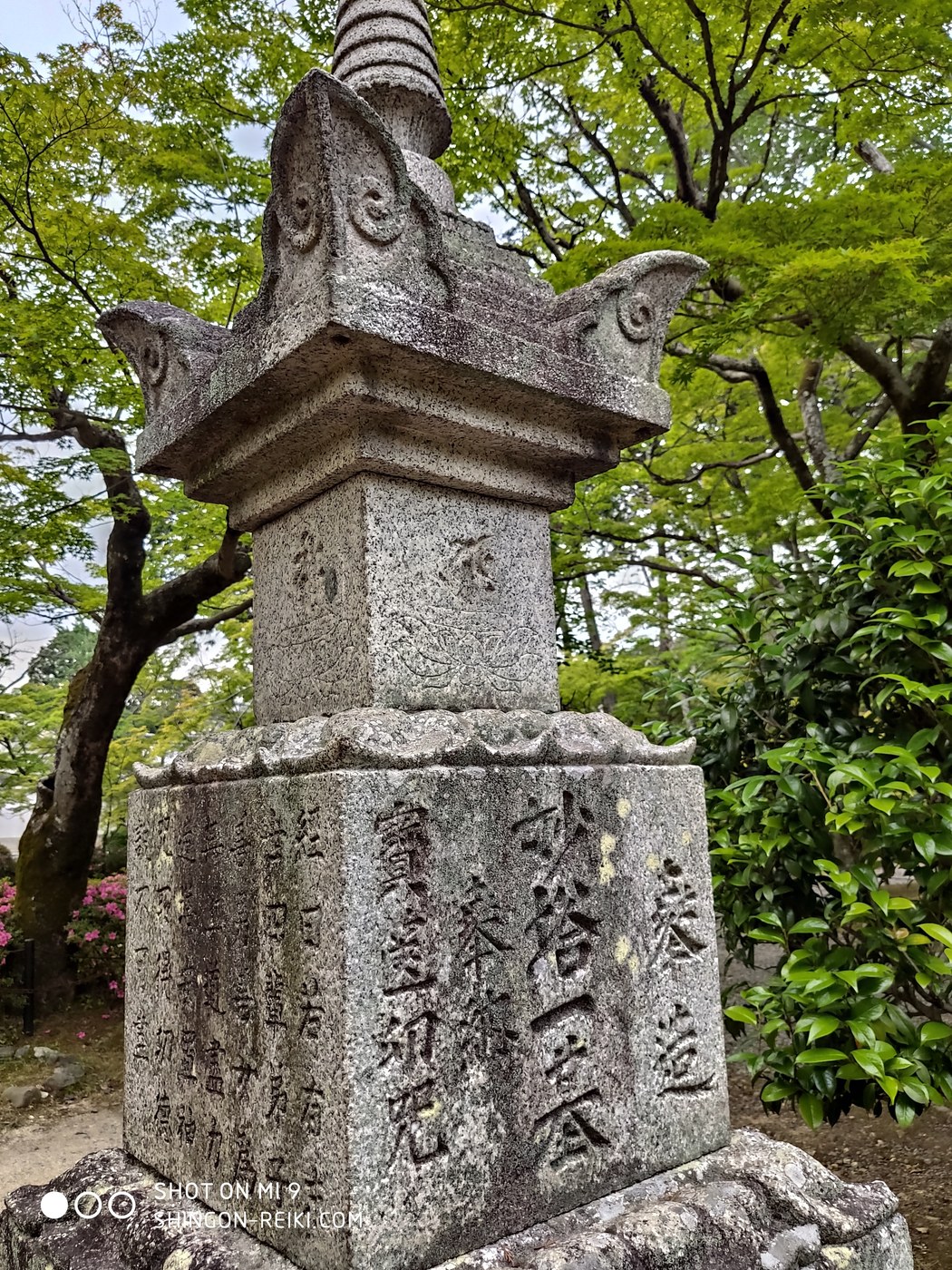
These signs are not abstract. In Japanese temples you find them on gravestones, on ritual objects, on stelae at the side of the path. Each one is an invitation: pause. A force is present here.
The Three Secrets — body, speech and mind
The effect of a Siddham does not unfold simply by looking at it. In the Shingon tradition they are applied within the framework of the Three Secrets — in Japanese 三密 Sanmitsu. Three layers that become active at the same time:
Body 身 — the sign is written with the hand or a mudra is formed. The hand movement is not arbitrary. It follows a specific stroke order, a direction, a rhythm. When written with the calligraphy brush, every stroke becomes meditation.
Speech 口 — the corresponding mantra is spoken. Loud, clear, three times. The sound activates the force held in the sign. Mantras are not prayers in the Western sense. They are sound-tools — every syllable has its own vibration.
Mind 意 — the sign is visualised with the inner eye. It is seen as luminous, radiant, expanding. The contemplation connects one's own mind with the spiritual force that the Siddham represents.
"According to the sūtras of esoteric Buddhism, the effect is most powerful through the application of the Three Secrets."
— Dr. Mark Hosak, Reiki in der therapeutischen Praxis (Reiki in Therapeutic Practice)This principle of three simultaneous layers — body, speech and mind — is at the heart of the entire Shingon practice. It does not apply only to Siddham. It applies to every ritual, every meditation, every application of the Reiki symbols.

Siddham and the Reiki symbols
Anyone who practises Reiki knows symbols. You draw them with the hand, speak a mantra, visualise their effect. This three-part principle — hand, voice, mind — is exactly the Sanmitsu of esoteric Buddhism. That is not coincidence.
The Reiki symbols come from several traditions: from esoteric Buddhism 密教 Mikkyō, from Japanese Shintō 神道, and from 修験道 Shugendō, the way of the mountain ascetics. The mental healing symbol — SHK — is a stylised abstraction of the Siddham Hrīḥ, the seed syllable for attaining the heart of awakening.
The Siddham Hrīḥ stands for a state in which the mind becomes pure and complete — free from the causes of suffering. The connection is direct: when you apply the SHK symbol, you work with a force that goes back to this Siddham. The form has been simplified over the centuries, but the ritual core — Three Secrets, seed syllable, spiritual connection — is the same.
The way the Reiki symbols are applied — drawn with the hand, intoned with the mouth, visualised in the mind — is the direct transmission of the Sanmitsu principle from esoteric Buddhism. In Shingon Reiki, this connection is consciously preserved and deepened.
Why calligraphy is not decoration
In Japan and China, calligraphy is a ritual practice. Not handwriting. Not design. A form of meditation in which forces are transferred into the signs through mindful, contemplative writing. This applies to kanji, and even more so to Siddham.
Mark Hosak studied Japanese and Chinese calligraphy with a Zen monk. The correct stroke order, the direction of every movement, the rhythm of the brush — none of this is aesthetic decoration. It is the bodily dimension of Sanmitsu. The one who writes a Siddham activates it. The one who writes it incorrectly or arbitrarily changes its form weakens its effect.
"The conscious or unconscious altering of the symbols brings with it a weakening of the effect. For the rituals one needs the original form of the signs, so that they may work optimally."
— Dr. Mark Hosak, Reiki in der therapeutischen Praxis (Reiki in Therapeutic Practice)This is also why the Siddham were preserved in Japan with such care. In India itself, the script developed and changed. In Japan, the forms from the 9th century were preserved — because they were kept as ritual tools, not as everyday writing. Any change would have impaired the ritual function.
Mark's research — three years in Japan
The Siddham are at the centre of Mark Hosak's academic research. His doctoral thesis at the University of Heidelberg is titled "Die Siddham in der japanischen Kunst — Rituale der Heilung" (The Siddham in Japanese Art — Rituals of Healing). For three years he researched in Japan — in temples of the Shingon and Tendai schools, in archives, in direct encounter with living practice.
What he discovered there goes far beyond academic knowledge. The Siddham are not only historical artefacts. They are still used in rituals today — at initiations, at ceremonies of healing, in the daily practice of monks. Mark did not only study them. He practised them. In temples, under the guidance of masters, in his own meditation.
This connection of scholarship and lived experience is what makes Shingon Reiki distinctive. Those who receive the symbols here do not receive them as an abstract system. They receive them within a lineage that reaches back to the original Siddham practices of esoteric Buddhism.
What the Siddham mean for you
You do not have to be a Japanologist to feel the force of the Siddham. In Shingon Reiki they are present — in the symbols, in the mantras, in the way the initiation is transmitted. When you draw a Reiki symbol with the hand, speak its mantra and see it with the inner eye, you are practising Sanmitsu. You stand within a lineage that reaches through Kūkai back to the ancient ritual texts.
The Siddham are a reminder that Reiki is not a modern wellness product. It is rooted in a tradition over a thousand years old that understands body, voice and mind as one. A tradition in which a single sign — written correctly, spoken correctly, visualised correctly — can open a door.
The Siddham are not waiting in museums. They are waiting in the practice. Every time you draw a Reiki symbol and speak its mantra, you activate a principle that rests on the sacred signs of Shingon. The difference in Shingon Reiki: here you know where it comes from.
Experience the tradition behind the symbols
Shingon Reiki connects you with the authentic roots of Reiki practice. Discover what stands behind the symbols — in direct experience.