Wrath is one of the most powerful energies a human being can experience. It burns, it concentrates, it destroys — and that is exactly why it has a special place in the Shingon tradition. Not as something to be suppressed, but as raw material. As energy that can be transformed. The bodhisattva who stands for this transformation is Kongōsatta 金剛薩埵 — the diamond bodhisattva. And what he does with wrath, guilt and karmic attachments is the opposite of what one expects in the West.
In many spiritual traditions, wrath is regarded as an obstacle — something to let go of, dissolve or overcome. In the Shingon tradition, wrath is not an illness. It is a diamond that has not yet been cut.
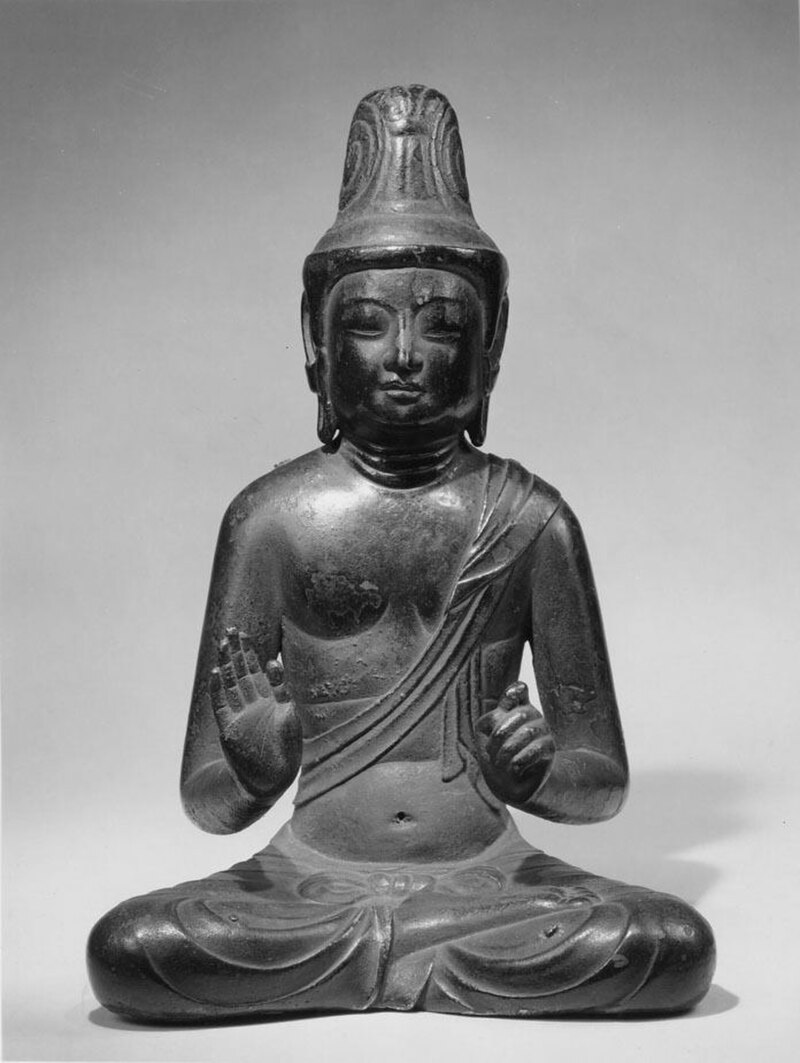
The name — what does Kongōsatta mean? 金剛薩埵
The vajra (Kongō) is the central symbol of esoteric Buddhism. It stands for the indestructible nature of enlightenment — the truth that nothing can damage. Not suffering, not ignorance, not the most violent emotions. Kongōsatta embodies this principle as a living being: he is the proof that the diamond nature exists in every one of us — even when it lies hidden beneath layers of wrath, fear and habit.
Kongōsatta in the Shingon cosmology 金剛界
In the Kongōkai Mandala 金剛界曼荼羅 — the diamond-world mandala — Kongōsatta holds a central position. He stands in the inner circle, directly next to Dainichi Nyorai. In some depictions he is described as the first manifestation of the cosmic Buddha — the moment when formless enlightenment takes a shape.
That makes Kongōsatta the mediator between the absolute and the relative, between cosmic truth and human experience. He is the bodhisattva who builds the bridge — between what we are and what we could be. And the bridge is not built from avoidance, but from transformation.
The hundred-syllable purification 百字明
The most well-known practice associated with Kongōsatta is the hundred-syllable purification — the Hyakuji Myō 百字明, in Sanskrit Śatākṣara Mantra. It is one of the longest and most powerful mantras in the Buddhist tradition. A hundred Sanskrit syllables recited in a specific order — each syllable a purification, a transformation, a cut through karmic attachments.
In the Tibetan tradition this mantra is regarded as one of the "four foundational practices" (Ngöndro) — 100,000 repetitions before the practitioner is admitted to higher practices. In the Japanese Shingon tradition the Kongōsatta practice is transmitted within a ritual frame — as part of the initiation, not as mechanical repetition.
What transformation really means 転
In the West there is a misunderstanding about what "transformation" means in the Buddhist tradition. It is not about replacing wrath with love, exchanging anger for peace, or converting negative feelings into positive ones. That would be suppression in spiritual clothing.
The Shingon tradition understands transformation differently. Wrath is energy. The same energy experienced as wrath can be experienced as clarity — when the attachment to the ego is released. The wrath does not disappear. The energy stays. But its quality changes. From blind wrath, seeing force. From reaction, action. From chaos, diamond.
That is what the vajra symbolises: the conversion of raw energy into indestructible clarity. Kongōsatta is the being who embodies this process — and in meditation the practitioner is invited to become this being. Not as an idea, but as direct experience.
Wrath is not an enemy. It is uncut diamond. The Kongōsatta practice takes the energy bound up in anger, guilt and fear and turns it — not into something else, but into its actual nature: clarity. This is not metaphor. It is a bodily experience encountered directly in meditation.

Kongōsatta and Reiki 靈氣
What does a diamond bodhisattva have to do with Reiki? More than meets the eye. In every Reiki session the practitioner meets energies that are not pleasant — blockages, condensations, emotional residues stored in the body. The instinct of many practitioners is to "send away" or "dissolve" these energies. But that is not always the right way.
The Kongōsatta perspective offers an alternative: do not regard the blocked energy as an enemy, but as raw material. Do not dissolve the condensation, transform it. Do not push the wrath away, make it permeable — until the clarity that always lay behind it shines through.
In Shingon Reiki this attitude becomes concrete: at the second level there are techniques that work directly with the transformation of difficult energies. Not through struggle, not through avoidance — but through presence. Through what the tradition calls Kaji 加持: the mutual interpenetration of cosmic force and human awareness. You stay. You hold the space. And the energy begins to turn — not because you force it, but because clarity is the natural form of energy when attachment is absent.
The three poisons and their transformation 三毒
In Buddhism the three fundamental causes of suffering are called Sandoku 三毒 — the three poisons: greed (Ton 貪), wrath (Jin 瞋) and ignorance (Chi 痴). In the Shingon tradition these three poisons are not fought — they are understood as veiled forms of the three wisdoms.
Greed — when attachment to the ego is released — reveals itself as the wisdom of discernment: the capacity to separate the essential from the inessential. Wrath — when self-reference becomes permeable — reveals itself as mirror wisdom: the capacity to see things as they actually are. Ignorance — when awareness opens — reveals itself as Dharmadhātu wisdom: the recognition of the true nature of all phenomena.
Kongōsatta is the bodhisattva who accompanies this process of transformation. His vajra does not cut out the poisons — it makes their true nature visible. That is why the Kongōsatta practice is not understood as correction, but as purification: not the removal of dirt, but the uncovering of what was always pure beneath.
Vajra and bell — the bodhisattva's tools 金剛鈴
In iconography Kongōsatta holds two objects: the vajra (Kongōsho 金剛杵) in his right hand and the bell (Kongōrei 金剛鈴) in his left. The vajra stands for indestructible clarity — the masculine, active, cutting force. The bell stands for the wisdom of emptiness — the feminine, receiving, all-encompassing quality.
Together they form a pair: clarity and wisdom, method and insight, compassion and emptiness. In the ritual practice of the Shingon tradition vajra and bell are used as physical tools — the monk holds them in both hands and through their connection activates the full unity of the two aspects of enlightenment.
The diamond within you
The Kongōsatta practice is part of the advanced path in Shingon Reiki. Find out how you can discover the energy of transformation for yourself.
Your path in Shingon Reiki Dainichi Nyorai