In Japan there is a word for something that most cultures sense but rarely name: the force that lives in a spoken sound. Not the meaning — the sound itself. Kotodama 言霊. The soul of words. And once you understand what kotodama is, you understand why the Reiki symbols do not work in silence — why they have to be spoken.
In Western Reiki, the symbol names are often repeated quietly inside the head. Think the name three times, visualise the symbol — done. That works to a certain degree. But in the Japanese tradition, the decisive element is missing: the voice. For in Shingon Buddhism, the voice is not an accessory — it is one of the three secrets.
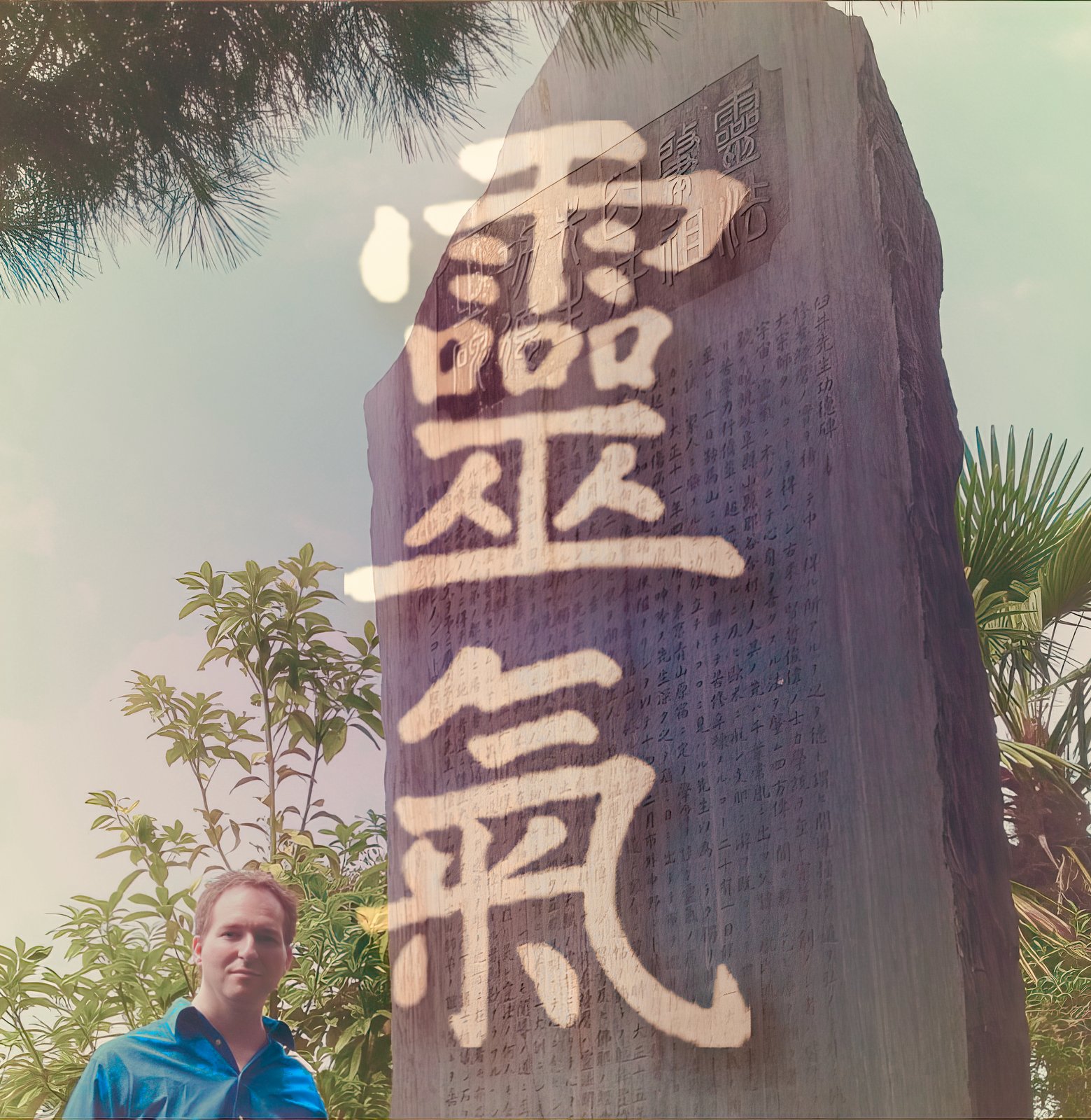
What is kotodama? 言霊
The idea is old — older than Buddhism in Japan. Already in the Man'yōshū, the great poem collection of the 8th century, Japan is described as Kotodama no sakiwau kuni — "the land in which the soul of words brings good fortune." In the Shintō tradition, prayers (Norito 祝詞) are not read — they are intoned, with a precisely fixed accent, rhythm and breath. Not because the kami need to understand the words, but because the sound itself produces the effect.
That is no metaphor. In Shintō cosmology, sound creates reality. When the primal kami Izanagi and Izanami brought forth the islands of Japan, they did so through spoken words. Sound came before form. First the sound — then the world.
Mantra in Shingon Buddhism 真言
When Buddhism came to Japan in the 9th century, Kūkai (Kōbō Daishi) did not bring only texts — he brought a religion of sound. The word Shingon 真言 means literally "true word" — the Japanese rendering of the Sanskrit term mantra. The whole school is named after the principle that sound carries truth.
Kūkai wrote in his works that the voice of Dainichi Nyorai — the cosmic Buddha — is the fundamental vibration of the universe. Every Siddham character is a frozen sound. Every mantra is a key that releases an aspect of this cosmic vibration. When a monk in a Shingon temple recites the mantra Oṃ Aḥ Vī Rā Hūṃ Khaṃ, he is not calling on a Buddha — he is activating the vibration that this Buddha is.
This is where kotodama and mantra meet. Shintō says: sound brings forth reality. Shingon says: sound is reality. Both traditions flow together in Reiki — for Mikao Usui came from a culture in which both were taken for granted.
Why the Reiki symbols must be spoken 符
In the Western Reiki tradition the symbol names count as secret words — you think them three times, draw the symbol and expect an effect. That is not wrong. But it is incomplete.
In the Japanese tradition a symbol is not only thought and drawn — it is spoken. Aloud or half-aloud, with intention and breath. The name of the symbol is no label — it is a mantra. And a mantra unfolds its full force only when it passes through the body: through the breath, through the vocal cords, through the lips.
This connects directly with the Sanmitsu — the three secrets of the Shingon tradition. Body (mudra), speech (mantra), mind (visualisation). When you only think and draw a Reiki symbol, you activate two of the three secrets. The third — speech — is missing. And it is precisely this third secret that is the resonant body which sets the energy vibrating.
Thinking is mind. Drawing is body. Speaking is speech. Only when all three work together does what the Shingon tradition calls Kaji 加持 arise — the mutual interpenetration of cosmic force and human awareness. In Shingon Reiki, no symbol is activated without speaking its name. That is no rule — it is physics. Sound physics.
The kotodama of the four Reiki symbols 四符
Each of the four classical Reiki symbols has its kotodama — its sonic core that works independent of the form of the sign. In the Japanese tradition there is the practice of using only the sound — without drawing the symbol. The sound alone is enough when it is spoken with the right intention and breath.
Cho Ku Rei
直靈Choku — direct, upright, immediate. Rei — spirit, soul, spiritual force. The sound draws energy in a straight line. It aligns, focuses, intensifies. In the Shintō tradition Cho Ku Rei stands for the direct spiritual force — the connection without detour. When you speak this sound, the energy is gathered.
Sei He Ki
聖壁Sei — sacred, pure. Heki — habit, tendency, pattern. The sound addresses the patterns that have settled in the mind — habits, imprints, emotional blocks. In the esoteric context, Sei He Ki corresponds to the Sanskrit Siddham for A — the primal sign that dissolves all patterns by leading them back to the source.
Hon Sha Ze Sho Nen
本者是正念Five characters, five syllables, one statement: "The true human being is right mindfulness." This kotodama bridges space and time — not as magic, but as the Buddhist insight that all phenomena are interconnected (Engi 縁起). When you speak this sound, you set up a connection that has always already been there.
Dai Ko Myo
大光明Dai — great. Kō — light. Myō — radiance, brightness, awakening. "The Great Radiant Light." This kotodama is the sound of awakening itself — the highest vibration in the Reiki tradition. In Shingon practice it corresponds to the light of Dainichi Nyorai pervading everything.

Siddham — the frozen sounds 悉曇
In Shingon Buddhism the Siddham characters (Bonji 梵字) are not simply letters. They are visual mantras — frozen sounds. Each Siddham represents a Sanskrit syllable, and each syllable is an aspect of the cosmic truth. When you see a Siddham, you "hear" the sound with the eyes. When you speak the mantra, you "see" the sign with the ears.
Kūkai described the Siddham as the body of Dainichi Nyorai. The cosmic Buddha does not speak in sentences — he speaks in single syllables, each containing an entire universe. The Siddham A (अ) — the first syllable, the origin of all sounds — contains, according to Kūkai, all the truths of Buddhism in a single sound. Whoever understands this sound understands everything.
In Shingon Reiki the Siddham are introduced as an extended practice. Every energy centre, every Buddha, every guardian deity has its own Siddham — and thus its own mantra. The combination of Siddham (visual), mantra (sonic) and mudra (bodily) produces the complete Sanmitsu activation.
Intonation — how mantras are spoken 唱
A mantra is not simply recited. It is intoned — with a particular pitch, a particular rhythm, a particular breath. In the Shingon temples of Japan there are centuries-old lineages of mantra intonation (Shōmyō 声明) passed on from master to receiver. The melody is not decoration — it is part of the effect.
In Reiki practice you do not have to be a monk to speak mantras effectively. But there are principles that make the difference: the sound comes from the hara, not from the head. The breath carries the mantra — the mantra rides on the breath. Repetition produces a vibration that builds, layer upon layer. After a hundred repetitions a mantra sounds different than after three — not because the words have changed, but because the space has changed.
Kotodama in daily practice 日課
The best-known kotodama practice in Reiki is the recitation of the Gokai — the five life principles. Usui explicitly instructed: kuchi ni tonaeyo — "recite with the mouth." Not think. Speak. The Gokai are not affirmations to be read silently. They are mantras. Their power unfolds through the spoken sound, carried by the breath, directed by the Gasshō posture.
Beyond this, in Shingon Reiki there is the practice of reciting the symbol names as mantras in their own right — even without giving a Reiki session. One hundred and eight repetitions of Dai Ko Myo in Gasshō — that is a complete meditation. The sound clears the mind. Repetition builds an energy field. And after a while you notice: you are no longer reciting — you are being recited.
Speak the symbol names aloud. Begin with the Gokai — morning and evening, in Gasshō, spoken aloud. Then the symbol names as mantra practice: 108 repetitions, from the hara, on the breath. The sound is no accessory — it is the third key. Without it two doors stay closed.
Discover the three secrets
Mudra, mantra, visualisation — kotodama is the second secret. In Shingon Reiki you experience all three.
Your path into Shingon Reiki The Reiki symbols