Spinal Reiki names the focused energy work along the spine with the methods of the Shingon Reiki tradition. Reiki hand positions are applied from the neck to the tailbone, combined with the visualisation of Siddham syllables, mantras, and the Gorin system of the five elements. In many spiritual traditions, the spine is considered the central energy channel of the body — in India as the Sushumna, in Japan as the seat of Ki flow. In Shingon Reiki, this ancient insight becomes concrete practice.
Whoever lays their hands for the first time on another person's spine — attentively, vertebra by vertebra, from top to bottom — feels something astonishing. Beneath the hands it pulses. Some places are warm, others cool. At some vertebrae the energy seems to stagnate, at others it flows immediately. The spine is no silent bone. It is a map. And whoever learns to read it learns something about the whole human being.
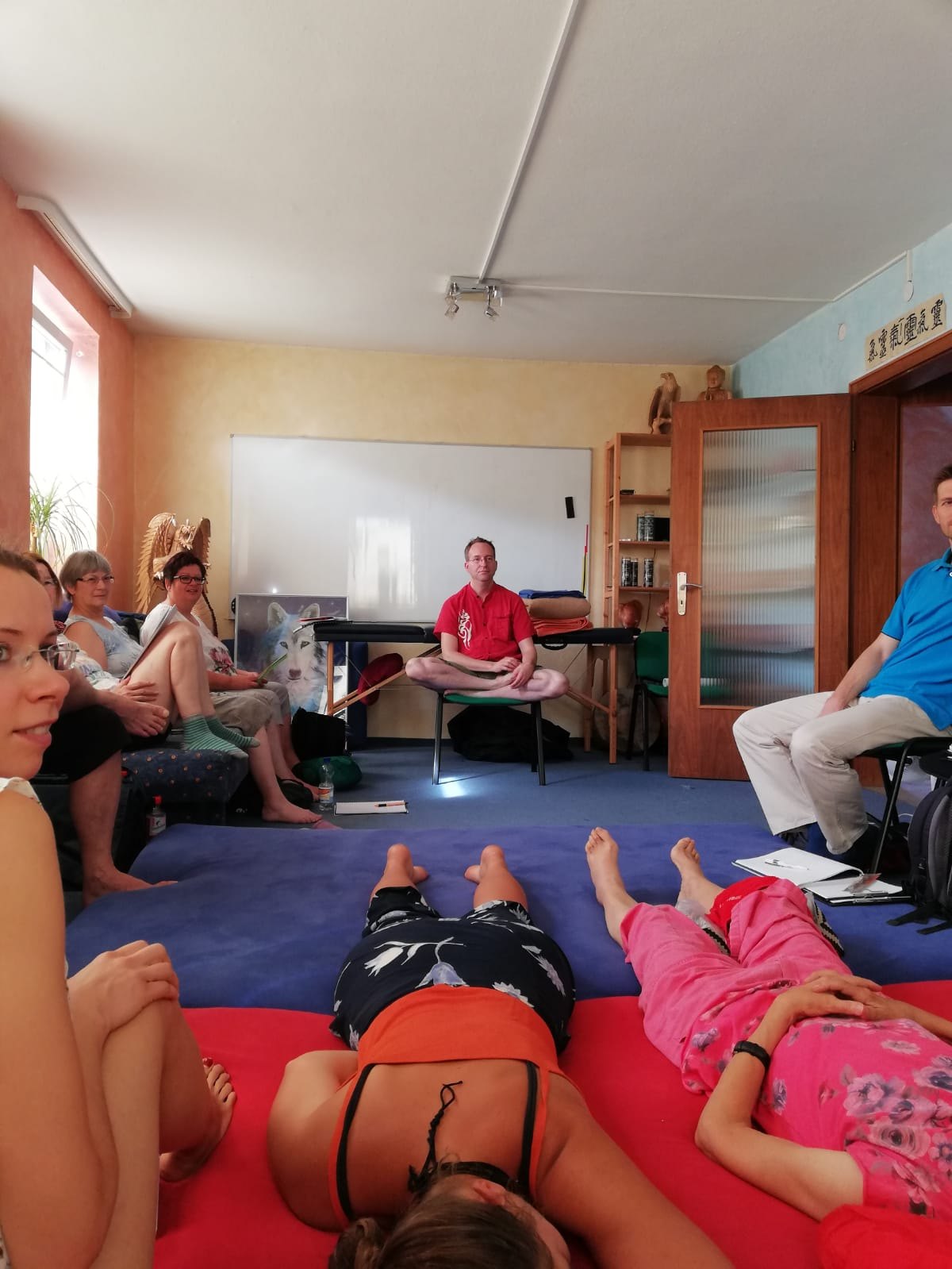
The spine as the axis of the worlds 脊柱
In the Indian tradition, the central energy channel along the spine is called Sushumna-Nadi. It runs from the pelvic floor to the crown. At its lower end rests the Kundalini — a force often described as a sleeping serpent. When it awakens, it rises through the Sushumna and pierces the energy centres known as chakras.
In Japan there is no word for Kundalini. But the experience exists. In the writings of the Shingon tradition, Kūkai — the founder of the Shingon school — describes how the cosmic force of Dainichi Nyorai 大日如来 manifests in the practitioner's body. This force does not rise from below to above like a serpent. It pervades the entire body all at once — from crown to soles, from inside to outside. And the spine is the central axis.
In the shamanic and Daoist roots that have flowed into the Shingon tradition, a similar image is found: the human being as link between heaven and earth. The spine is the axis that connects both. It is not only bone and cartilage — it is the vertical line on which the cosmic and the earthly meet.
Siddham and the Gorin system along the spine 梵字
In Shingon Buddhism, the five great elements — earth, water, fire, wind, and space — are imprinted on the body as a mandala. Each element has its Siddham syllable, its colour, and its body zone. In the spinal practice of Shingon Reiki, these five zones are not thought abstractly but experienced concretely: the hands move from zone to zone, and in each zone the corresponding Siddham is visualised.
Tailbone and pelvis belong to the element earth — Chi 地. Here lies the foundation, the gravity, the rooting. The Siddham A is visualised. The hands rest on the lower back, and what many describe in this moment is a sense of arrival and stillness.
The lumbar spine corresponds to the element water — Sui 水. Flowing, releasing, adapting. Here also lies the area of the Hara, of the Tanden — the centre of life force in the Japanese tradition. The Siddham Vaṃ shines in inner sight. Many experience deep emotions in this region that may gently release.
The middle back belongs to fire — Ka 火. Transformation, digestion, inner warmth. The Siddham Raṃ. Higher still: the chest area as wind — Fū 風 — with the Siddham Haṃ. Breath, movement, expansion. And finally the neck and back of the head as space — Kū 空 — with the Siddham Khaṃ. Vastness, stillness, pure awareness.
When the hands move slowly down the spine and in each zone the corresponding Siddham is held, an experience arises that goes beyond ordinary laying on of hands. The body becomes a stupa, a temple — exactly as the old Shingon texts describe. That is no theory. It is something one can sense beneath the hands.
Forgiveness meditation and the spine 許し
There is a connection that Western anatomy does not know but that becomes experiential again and again in practice: the spine stores emotions. Not as metaphor — as bodily reality. Whoever works regularly with the hands on people's spines knows the phenomenon. At particular vertebrae the energy stagnates. The spot is hard, cramped, cold or excessively hot. And when the energy begins to flow there, sometimes images, memories, tears come.
In Shingon Reiki, forgiveness meditation therefore belongs to the work with the spine. Forgiveness — not as a moral imperative, but as an energetic process. Old emotions that have settled in the tissue may release. Resentment, sorrow, shame — all that we carry in the back, often without knowing. Forgiveness meditation opens space. It compels nothing. It invites. And the spine answers.
In the Buddhist tradition there is the concept of Kaji 加持 — the blessing transmitted through ritual and intention. In the spinal practice, Kaji is linked with the force of Dainichi Nyorai: the cosmic Buddha whose light pervades all things. The hands become a channel. And what flows through them is not the practitioner's personal force but the force of the universe itself.
This linking of forgiveness meditation, Kaji, and Siddham visualisation makes the spinal practice in Shingon Reiki one of the most far-reaching experiences possible in this tradition. It is bodywork and spiritual practice in one — touch as ritual, as it has been practised in the Shingon temples of Japan for centuries.
Buddhist massage and the Inner Smile 仏身
Touch in the Shingon tradition is not a purely therapeutic act. It is spiritual practice. Buddhist massage — as practised in Japanese temples — links attentive bodywork with mantra and visualisation. The hands touch not only the body. They touch the Ki field. And they carry an intention that goes beyond the physical.
In the spinal practice of Shingon Reiki, this attitude becomes concrete. Every hand position on the back is not only a technique — it is an encounter. The practitioner meets the energetic field of the other person with presence, with Siddham, with mantra. And sometimes something happens that is hard to put into words: a stillness that spreads. A space that opens. A warmth that comes from within.
In addition to the Reiki practice, Shingon Reiki also works with a method that comes from Qigong: the Inner Smile. One directs friendly attention in turn to the inner organs — heart, lungs, liver, kidneys, spleen. One smiles to them. It sounds simple. But the effect many experience is astonishing: the organs answer. They grow warm. They relax. And the smile spreads — through the whole body, through the entire spine.
In Shingon Reiki, three streams flow together: the energy work of Reiki, the ritual force of the Siddham, and the bodily near-practice of Buddhist touch. The spine is the place where all three streams meet. Here the body becomes a temple — not as idea, but as experience beneath the hands.

Discover Shingon Reiki
Spinal Reiki with Siddham, forgiveness meditation, and Kaji — a practice that touches the whole human being. Find out which entry point fits you.
Your path into Shingon Reiki Chakras and Reiki