Chakras are among the best-known concepts in the spiritual world. Seven energy centres running through the body — from the root chakra to the crown chakra. In Western Reiki practice, the chakras are often depicted with bright colours, like a rainbow along the spine. That looks pretty. But the story behind it is deeper, older, and more surprising than most assume.
The concept of energy centres in the body is not an Indian invention alone. It exists in many traditions — and in Japan it has its own distinct shape. In Shingon Buddhism, practitioners have worked for over a thousand years with the Gorin 五輪 — the five rings, the five elements that are imprinted on the body as a mandala. Each element has its Siddham syllable. Each syllable has its position in the body. And each position is a gate.

Chakra — what does the word mean? चक्र
Chakra comes from Sanskrit and means "wheel" or "circle." It describes vortices in the subtle anatomy where the energy channels (Nāḍī) converge. In the Indian tantras — especially in Haṭha Yoga — these wheels are described as nodal points where Prāṇa (life energy) is gathered, transformed, and released.
The most familiar depiction recognises seven main chakras: Mūlādhāra (root), Svādhiṣṭhāna (sacral), Maṇipūra (solar plexus), Anāhata (heart), Viśuddha (throat), Ājñā (forehead), and Sahasrāra (crown). In Western reception, these chakras have been paired with colours, stones, affirmations, and all kinds of correspondences. Some of this has roots in tradition — much of it is modern invention.
What is almost always missing in popular accounts: the Indian chakra tradition is not monolithic. Depending on the text, school, and era, the number of chakras varies considerably. There are systems with five, six, nine, eleven, or twenty-one chakras. The seven-chakra system is only one among many — and it became the dominant depiction in the West because a single book in the twentieth century made it popular.
The Japanese system — Gorin instead of chakra 五輪
The Gorin system is not identical with the Indian chakra system, but it is related. Both share the same tantric origin: the idea that the human body is a microcosm that mirrors the structure of the universe. In India this became the chakra–nāḍī system. In Japan, filtered through Chinese esoteric Buddhism and Kūkai's Shingon school, it became the Gorin — the body mandala.
The decisive difference: in the Gorin system, the foreground is not seven energy centres but five elements that pervade the entire body. Each element is not just a point — it is a zone, a principle, a vibration. And each element is paired with a Siddham syllable that is projected onto the body in meditation.
The five elements and their Siddham 梵字
Kakuban, the great reformer of the Shingon tradition, wrote in the twelfth century the Gorin kuji myō himitsu shaku — the "Secret Explanation of the Five Wheels and Nine Syllables." In this text he links the five Siddham with the five body zones and with the inner organs. The result is a complete system of energy work — 900 years before the West knew the word "chakra."
Earth · Chi 地
Solidity, stability, bones and flesh. The foundation. In the Gorin system, earth is the lowest ring — the body that bears. The Siddham A is at the same time the most universal of all syllables: the origin, the un-arisen.
Water · Sui 水
Flowing, adaptation, fluid. Blood, lymph, everything that streams. The body zone covers the lower abdomen — the area the Japanese tradition knows as the Hara. Here life force gathers.
Fire · Ka 火
Transformation, digestion, inner warmth. The zone of the solar plexus and the digestive organs. In the Shingon tradition, fire stands for transforming force — the same force made visible in the Goma fire ritual (Goma-hō).
Wind · Fū 風
Movement, breath, expansion. The zone of the heart and lungs — where the breath flows. Wind is the element of communication, of pulsation, of life rhythm.
Space · Kū 空
Emptiness, vastness, awareness. The fifth element covers the head — the seat of mind. In Shingon Buddhism, space is not nothing, but that within which everything arises. Universal potential.
Together these five elements form the Gorin Mandara 五輪曼荼羅 — the body mandala. In meditation, the five Siddham are projected onto the corresponding body zones. The practitioner becomes a living mandala — microcosm and macrocosm coincide.
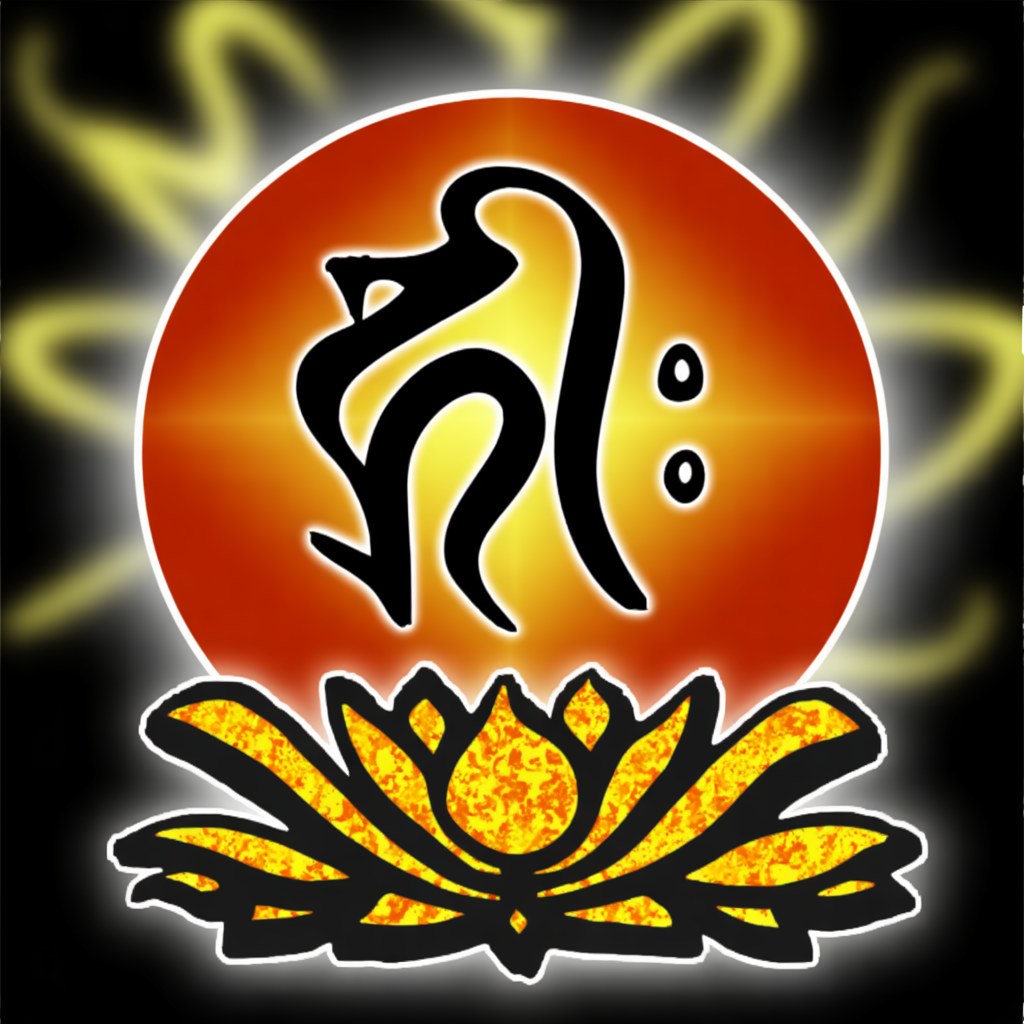
Seven chakras and Siddham in Shingon Reiki 七
In Shingon Reiki, both systems are brought together: the Indian seven-chakra system and the Japanese Gorin. In his research and practice, Mark Hosak built the bridge — to each of the seven main chakras a specific Siddham syllable is paired, visualised in meditation and activated through mantra.
This pairing is not an arbitrary assemblage. It is based on the historical sources of the Shingon tradition, in which particular Buddhas and Bodhisattvas are paired with particular body zones — and each Buddha has its own Siddham. When you work with the heart chakra in Shingon Reiki, you don't simply visualise a green colour. You see the Siddham syllable of the Buddha that corresponds to this centre. You recite his mantra. You form his mudra. Three secrets — Sanmitsu — directed at a single energy centre.
In Western Reiki one works with the chakras as colour points. In Shingon Reiki one works with them as gates to the Buddhas. Every chakra becomes a ritual. Every energy centre has a face, a sound, a syllable. That is the difference between a chakra meditation as a relaxation exercise — and a chakra practice as part of a 1,200-year-old transmission lineage.
Gorintō — the body as stupa 五輪塔
When you visit a graveyard in Japan, you see Gorintō 五輪塔 everywhere — five-element towers. Five stones stacked on each other: a cube (earth), a sphere (water), a pyramid (fire), a half-sphere (wind), and a lotus bud (space). On each stone a Siddham syllable is engraved.
These stupas don't only stand in graveyards. They mark sacred places, line pilgrimage routes, and stand in temple gardens. The Gorintō is a three-dimensional rendering of what is experienced in meditation as the body mandala: the body as stupa, as sacred place, as temple. The human body — not as a vessel that contains a soul, but as a mandala in which the universe becomes visible.
Kakuban makes this connection explicit in his writings: the five Siddham on the five body zones strengthen the organs and prolong life. That is not a metaphor. It is a practice instruction transmitted in the Shingon tradition since the twelfth century — and it is alive in Shingon Reiki.
Hara — the centre the West forgot 腹
In Western chakra depictions, the "sacral chakra" lies in the lower abdomen — and there it is given an orange colour and the assignment "creativity and sexuality." In Japan this region carries far greater significance. It is called Hara 腹 — and it is the centre of everything.
In Zen one speaks of the Tanden 丹田 — the "elixir field," three finger-widths below the navel. In the martial arts, the Hara is the anchor of every movement. In the tea ceremony one sits from the Hara. In calligraphy the brushstroke flows from the Hara. There is no concept in Japanese culture more important than this centre.
In Shingon Reiki the Hara is the place where energy is gathered — in the Jōshin Kokyū Hō breath practice, in Siddham meditation, in every session. It is not one chakra among seven. It is the gravitational centre of the entire practice.
Chakras in Reiki practice 靈氣
In every Reiki session — Western or Japanese — the work with the energy centres plays a central role. The hands are placed in particular positions, often corresponding to the chakras. But the difference lies in the depth.
In Western Reiki, the hand positions are passed on as a standard scheme: head, forehead, throat, heart, solar plexus, lower abdomen, root. In Shingon Reiki, the same positions are understood not only as energy centres, but as places where cosmic principles manifest. The hands lie not on a "chakra" — they lie on a gate. And through that gate, a Buddha looks.
That changes perception during a session fundamentally. Whoever works with Siddham, mantra, and mudra experiences the energy centres not as abstract colour points, but as living forces — each with its own character, its own quality, its own presence.
In Shingon Reiki, every energy centre has three keys: a Siddham syllable, a mantra, and a mudra. When all three are activated at once, the centre opens in a way that goes beyond simple laying on of hands. The three secrets — Sanmitsu — turn every Reiki session into a complete ritual practice.
Experience the differences
Chakras with Siddham, mantra, and mudra — that is how Shingon Reiki works. Find out which entry point fits you.
Your path into Shingon Reiki The Reiki symbols