A single sound. No word. No sentence. Only a sound — and within this sound an entire universe lies. This is how the Siddham syllables work. Each one is a condensation of cosmic force, a sonic gate to a Buddha, a bodhisattva, a principle of the universe. Whoever speaks them does not merely produce a sound. They enter into resonance with a force older than any human language.
In the Shingon tradition 真言宗, these syllables are not abstractions. They are alive. They are spoken, visualised, experienced in meditation. Every Shingon monk knows them. Every practitioner meets them. And those who understand what stands behind them also understand the root of the Reiki symbols.

What are seed syllables? 種子
In Sanskrit they are called bīja — seeds. In Japanese 種子 (Shuji) — seed signs. The metaphor is precise: just as a tiny seed contains an entire tree, a single Siddham syllable contains the whole force and wisdom of a Buddha. Not as a symbol. Not as a memory. As actual presence.
To the Western mind that sounds strange. How can a letter be a Buddha? But in the Shingon tradition the boundary between sign and reality is permeable. The sound A is not a reference to Dainichi Nyorai — it is Dainichi Nyorai in his sonic manifestation. The Siddham character for A is not an image of Dainichi — it is his visual manifestation. Sound, sign and being are one.
A seed syllable contains the whole Buddha — as a seed contains the whole tree. The one who speaks the syllable plants the seed. The one who meditates on it lets it grow. The one who takes it in becomes the tree.
A — the primal syllable and Dainichi Nyorai 阿
Everything begins with A. In every language of the world it is one of the first sounds a child makes. The mouth opens, the breath flows out, and the sound arises — without effort, without tongue, without lips. Pure. Open. Unfiltered. In the Shingon tradition A is not only the first letter. It is the origin of all language, all sounds, all manifestation.
Meditation on the syllable A — the Aji-Kan 阿字観 — is the core practice of Shingon Buddhism. Monks on Mount Kōya, the sacred mountain where Kūkai (Kōbō Daishi) founded the Shingon school, practise it daily. In the darkness before dawn. By the light of a single candle. Before them the Siddham character A, painted on a moon disc above a lotus blossom.
The practitioner sits. Breathes. Directs the gaze to the sign. And then something happens that cannot be put into words — and yet has been borne witness to by practitioners for over a thousand years: the boundary between the one who looks and what is seen dissolves. The A is no longer outside. It is within. And that which was within — the small, separate self — recognises itself as part of the great. As manifestation of Dainichi Nyorai.
Vaṃ — two faces of Dainichi 金胎
Dainichi Nyorai has two aspects, depicted in the two great mandalas of Shingon. Two sides of the same cosmic reality. And each has its own seed syllable.
Two mandalas. Two syllables. Two aspects of the same reality. In Shingon Buddhism, both mandalas are always considered together — for wisdom without compassion is cold, and compassion without wisdom is blind. They belong together like inhalation and exhalation. Like the left and the right hand in Gasshō 合掌, the joining of the palms.
This duality within unity — it is one of the deepest principles of Shingon. And it resonates in Reiki practice as well: the unity of giving and receiving, of intention and surrender, of active doing and silent allowing.
Hrīḥ — Amida Nyorai and Kannon 弥陀
If A is the origin, then Hrīḥ is the answer. The syllable Hrīḥ embodies Amida Nyorai 阿弥陀如来, the Buddha of immeasurable light and infinite life. And it embodies at the same time Kannon 観音, the bodhisattva of compassion — the being who hears the sound of the world and answers every call.
Hrīḥ is the syllable of compassion. When a Shingon monk recites Hrīḥ, he does not connect with an abstract idea of compassion. He enters into resonance with the force embodied in Amida Nyorai — the force that gives up no being, that is reachable in every moment, that shines without condition. Like a light that does not ask whom it lights.
Kannon — Avalokiteśvara in Sanskrit — is perhaps the best-known being in all of East Asian Buddhism. In Japan, Kannon stands at the side of paths, in temples, on mountains. Kannon takes any form needed to meet the suffering beings. And Kannon's seed syllable is Hrīḥ — the sound that says: I hear you. I am here.
Hrīḥ is not a prayer to a distant Buddha. It is the sound of compassion itself — spoken, heard, experienced. The one who speaks Hrīḥ does not call out to Kannon. He lets Kannon work through him.
Kiriku — Amida in another form 光明
The syllable Kiriku (also Kirikku) is another seed syllable for Amida Nyorai. In Japan you encounter it often on gravestones, on Gorintō 五輪塔 — the five-tiered stone towers that represent earth, water, fire, wind and emptiness. Kiriku at the top of the Gorintō means: the deceased is held in Amida's light.
Throughout Japan you find these signs — on old cemeteries, on mountain peaks, along pilgrim paths. Most people walk past without noticing them. But anyone who knows the Siddham syllables suddenly sees messages everywhere. On every stone, at every temple gate. The Buddhas have left their signs. You only need to open your eyes for them.
Further seed syllables — a universe in sounds 五仏
The five wisdom Buddhas 五智如来 of the Kongō-kai Mandala each have their own seed syllable. Together they form a sonic mandala — a map of the cosmos in five sounds:
Five Buddhas. Five syllables. Five aspects of one cosmic wisdom. In Shingon meditation they are not recited one after another like a list. They are experienced as unity — as a single sound that unfolds in five directions. Like white light fanning into all colours through a prism.
Aji-Kan — the core practice of Shingon 阿字観
Aji-Kan 阿字観 — meditation on the syllable A — is the central meditation practice of Shingon Buddhism. No other practice is so fundamental, so simple in its arrangement and so inexhaustible in its depth.
The practitioner sits before an image: the Siddham character A, written in gold on a white moon disc, resting on an eight-petalled lotus. Three elements. The lotus stands for the mind that rises from the mud of the world without being soiled. The moon disc stands for the clarity of awakened awareness. And the A stands for truth itself — the unborn, the indestructible, that which was there before any beginning and will be there after every end.

The practice begins with posture. With the breath. With the gaze on the sign. Then the syllable A is spoken softly — or heard inwardly. Not as a mantra in the sense of mechanical repetition. As entry into a vibration that pervades the whole body. The sound becomes breath. The breath becomes sign. The sign becomes experience.
On Mount Kōya there are temples that offer Aji-Kan sittings to visitors. You sit in a darkened hall, before the image, surrounded by silence and the scent of incense. And even people who have never meditated speak of a stillness deeper than stillness. Of a feeling of having arrived. Not somewhere. Here. In this moment. In this sound.
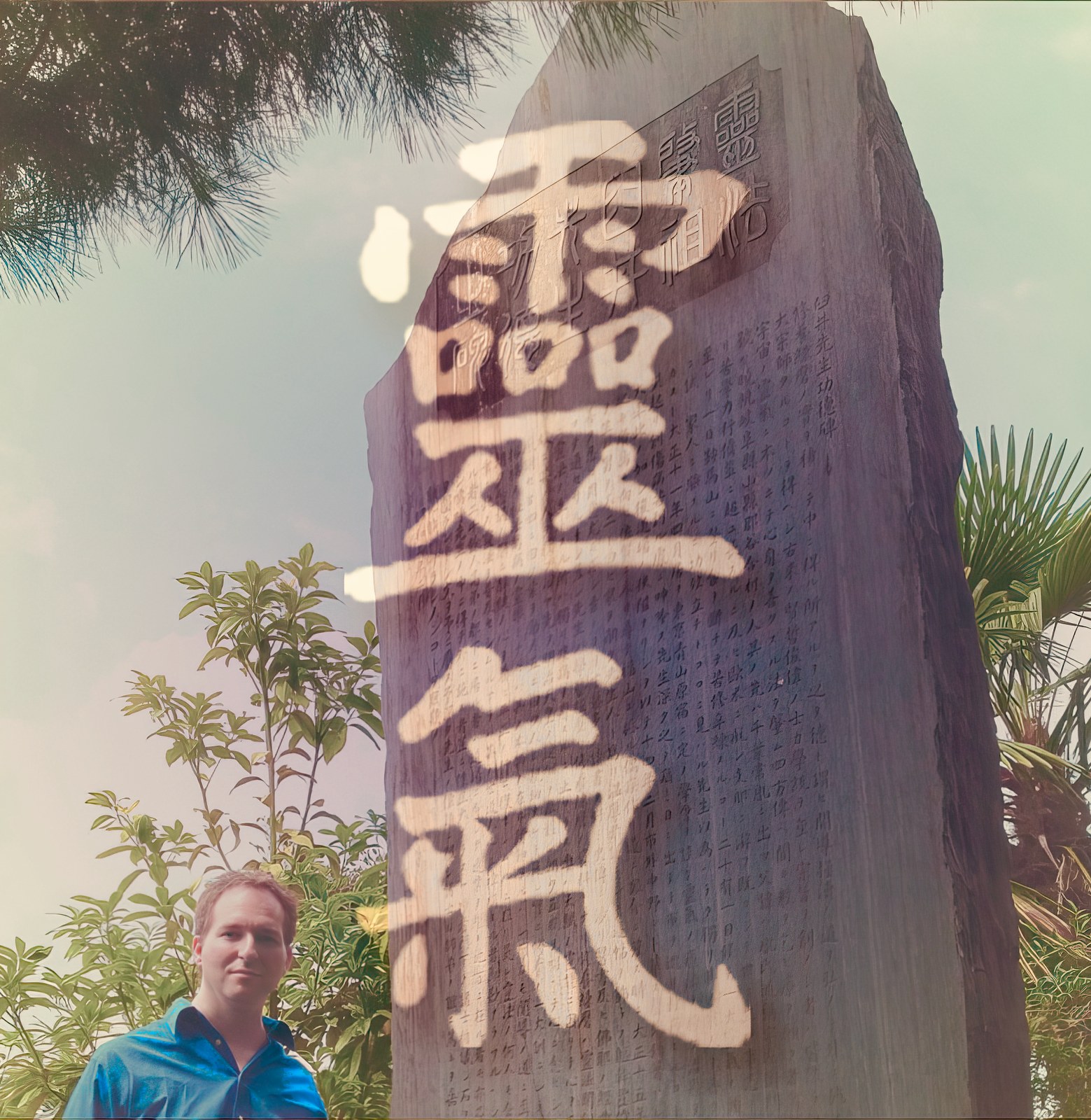
Siddham syllables and the Reiki symbols 靈氣
Here the connection becomes visible that most Reiki books leave out. The Reiki symbols work according to exactly the same principle as the Siddham syllables. A sign is not "applied" as a tool. It is experienced as an object of meditation. It is not drawn mechanically — it is taken inward. Sound, sign and force are one.
Dai Ko Myo — the master symbol in Reiki — already carries this connection in its name: 大光明, "the Great Radiant Light." It describes the same experience of light that arises in the Siddham meditation on A — the light of Dainichi Nyorai, the great sun pervading everything. The form is different. The principle is identical.
Those who know the Siddham syllables understand the Reiki symbols on a level beyond technique. They recognise: these signs are not arbitrary. They stand within a lineage that reaches from the Indian Siddham through the Chinese dhāraṇī masters and Kūkai to Mikao Usui. An unbroken tradition of force-transmission through sacred signs.
The Siddham syllables are the ancestors of the Reiki symbols. The same principle — a sign that is not used but experienced — runs from the monasteries of India through the temples of Japan into Reiki practice today. Those who know the root understand the tree.
The actual experience — how the syllable A feels in the body, how Hrīḥ spreads in the heart space, how Vaṃ leads the mind to a clarity beyond words — does not belong in a text. It belongs in practice. In direct transmission. In the space between two people where the sacred becomes felt.
What can stand here is the invitation: these syllables are waiting. For over a thousand years. They wait to be heard — not only with the ears, but with the whole being. And perhaps, while reading this article, you have already felt that something is vibrating. A sound beneath the sound. A knowing beneath the knowing. That is the syllable A. It was always already there.
Your path into Shingon Reiki
The Siddham syllables unfold their depth in direct transmission. Discover which entry point fits you.
Your path The Siddham script