There are places in Japan where the air tastes different. Not because of the trees, not because of the rain — but because of what has been practised there for centuries. Yakushi temples are among these places. Whoever steps inside feels something hard to put into words: a stillness that is not empty, but full. Some describe it as warmth coming from within. Others as a sense of finally having arrived.
Yakushi Nyorai 薬師如来 — the Medicine Buddha — is one of the most venerated Buddhas in Japan. His name literally means "master of medicine" (Yakushi) and "thus-come one" (Nyorai). If you have already met the history and meaning of the Medicine Buddha, you know his central role in Japanese temple culture. This article is about something else: the meditation practice connected with Yakushi Nyorai — and what can be experienced within it.
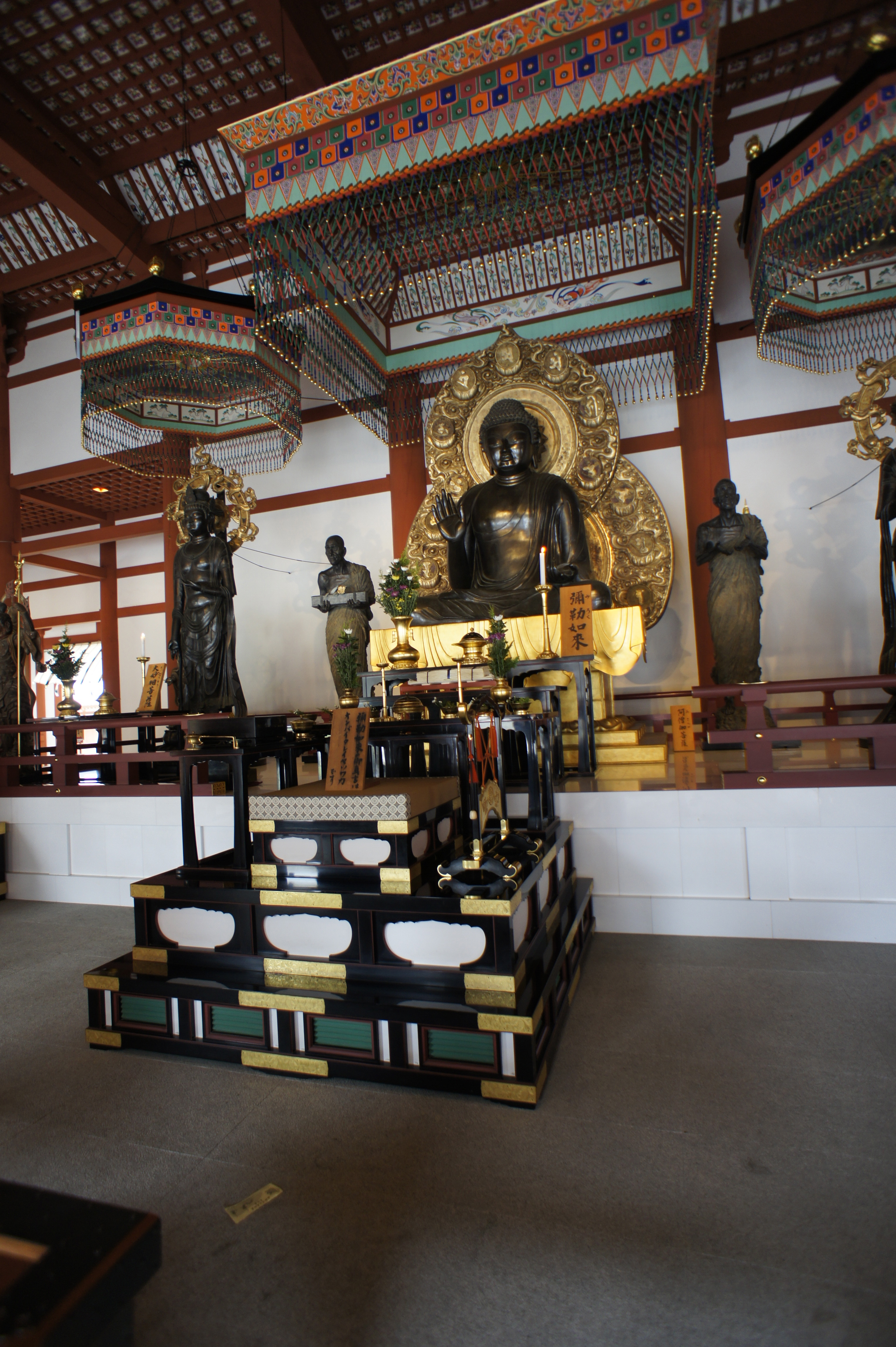
Lapis-lazuli light — the body of Yakushi Nyorai 瑠璃光
In the sutras Yakushi Nyorai is described as a Buddha whose body consists of lapis lazuli — a deep-blue, light-filled stone considered precious and protective since antiquity. His Pure Land, Jōruri 浄瑠璃, is a place of pure lapis-lazuli light. And in his left hand he holds a medicine bowl — some depictions show a lapis-lazuli sphere instead, glowing from within.
What does this mean for practice? In meditation with Yakushi Nyorai this light is not understood only as a symbol. It is described as actual experience — as light that pervades the body, cell by cell. Practitioners report that during meditation they perceive a deep blue spreading like water seeping into dry earth. Some feel warmth. Some feel a vastness in the chest. What exactly happens is individual — and can shift from session to session.
Yakushi Nyorai took twelve great vows before reaching Buddhahood. Each vow is a promise to all sentient beings: to strengthen their bodies, to calm their minds, to give them food and clothing, to lead them out of darkness. These are not abstract ideals. They are concrete commitments — and in Japanese temple practice these vows are kept alive in rituals for over a thousand years.
Mount Kurama and the link to Reiki 鞍馬
Anyone who looks into the origins of Reiki inevitably comes to Mount Kurama north of Kyoto. There, in 1922, Mikao Usui retreated to fast and meditate. What most people do not know: there is a Yakushi temple on Mount Kurama. The veneration of the Medicine Buddha has been rooted there for centuries.
That is no accident. The link between Reiki and Yakushi Nyorai runs deeper than it appears at first glance. In the traditions of esoteric Buddhism (Shingon), Shugendo, Shinto and shamanic Daoism — the sources from which Shingon Reiki also draws — Yakushi Nyorai is the central figure when it comes to the well-being of body and mind. His Siddham syllable is Bhai — a syllable that in meditation can be experienced both as sound and as inner image.

When Mark Hosak speaks about Yakushi Nyorai, an enthusiasm comes through that can only come from direct encounter. He has visited the Yakushi temples in Nara, Kyoto and on the Shikoku Pilgrimage — not as a tourist, but as a practitioner. He has sat in front of the statues, recited the mantras, taken the atmosphere of these places into himself. And in his PhD at Heidelberg University he researched how the Siddham syllables — including the Bhai of Yakushi Nyorai — are used in Japanese ritual art.
The meditation practice — mantra, mudra, visualisation 三密
Meditation with Yakushi Nyorai follows the principle of the three secrets — Sanmitsu 三密: body (mudra), speech (mantra) and mind (visualisation). These three layers are activated at the same time. The body forms a specific hand gesture. The mouth recites the mantra. The mind visualises the lapis-lazuli light of Yakushi Nyorai.
The mantra of Yakushi Nyorai is well known: On Koro Koro Sendari Matōgi Sowaka. It is one of the most frequently recited formulas in Japanese temples. The sound alone has a special quality — many practitioners describe it as calming, centring, as if something inside that had been moving comes to rest.
The full meditation practice with Yakushi Nyorai — including the specific mudra, the visualisation technique and the correct mantra recitation — is transmitted in the initiation. What is described here is the frame, not the practice itself. The transmission takes place from person to person, in the living tradition — as it has been passed on within the Shingon lineage for over 1,200 years.
The Siddham syllable of Yakushi Nyorai — Bhai — plays a central role in the meditation. In the Shingon tradition, Siddham are not understood only as written characters. They are bodies of sound, vehicles of energy, gateways. Whoever visualises the Siddham Bhai in meditation opens — as the sources describe — a space in which the power of Yakushi Nyorai becomes experienceable. That is no metaphor. It is a practice instruction documented in the old Shingon manuals.
In Shingon Reiki this practice is connected with work on the energy centres. The lapis-lazuli light is not visualised only as an abstract image — it is directed deliberately into specific areas of the body. Whoever has received the initiation carries the connection with Yakushi Nyorai within. The meditation deepens this connection. And with each sitting, what is experienced can shift and deepen.

What does this mean for everyday life? The Yakushi meditation is not a practice you do once and tick off. It is a path. In the temples of Japan the mantra is recited daily — morning and evening, as a fixed part of the ritual calendar. In Shingon Reiki the practice can be integrated into daily meditation. Some practitioners report that after weeks or months of regular practice something shifts: a deeper calm, a clearer body sense, a feeling of connectedness that remains beyond the meditation itself.
The Yakushi temples in Japan — whether the famous Yakushi-ji in Nara, the temples on the Shikoku Pilgrimage or the Yakushi temple on Mount Kurama — are still places where people come to find space. Space for themselves. Space for what is heavy right now. Space for what wants to come into being. These temples remind us that the practice of Yakushi Nyorai is not a theory. It is something that has been lived for centuries — and that is open to anyone willing to step into it.
Experience the practice
Meditation with Yakushi Nyorai is transmitted in the initiation — as part of the Shingon Reiki path. Find out which entry point fits you.
Your path in Shingon Reiki The Medicine Buddha