In the West the Akashic record is known as a cosmic memory — a field in which all knowledge that has ever existed is stored. There is much speculation about it in esoteric circles. But hardly anyone asks: where does the idea come from? And is there something in the old traditions of East Asia that corresponds to it?
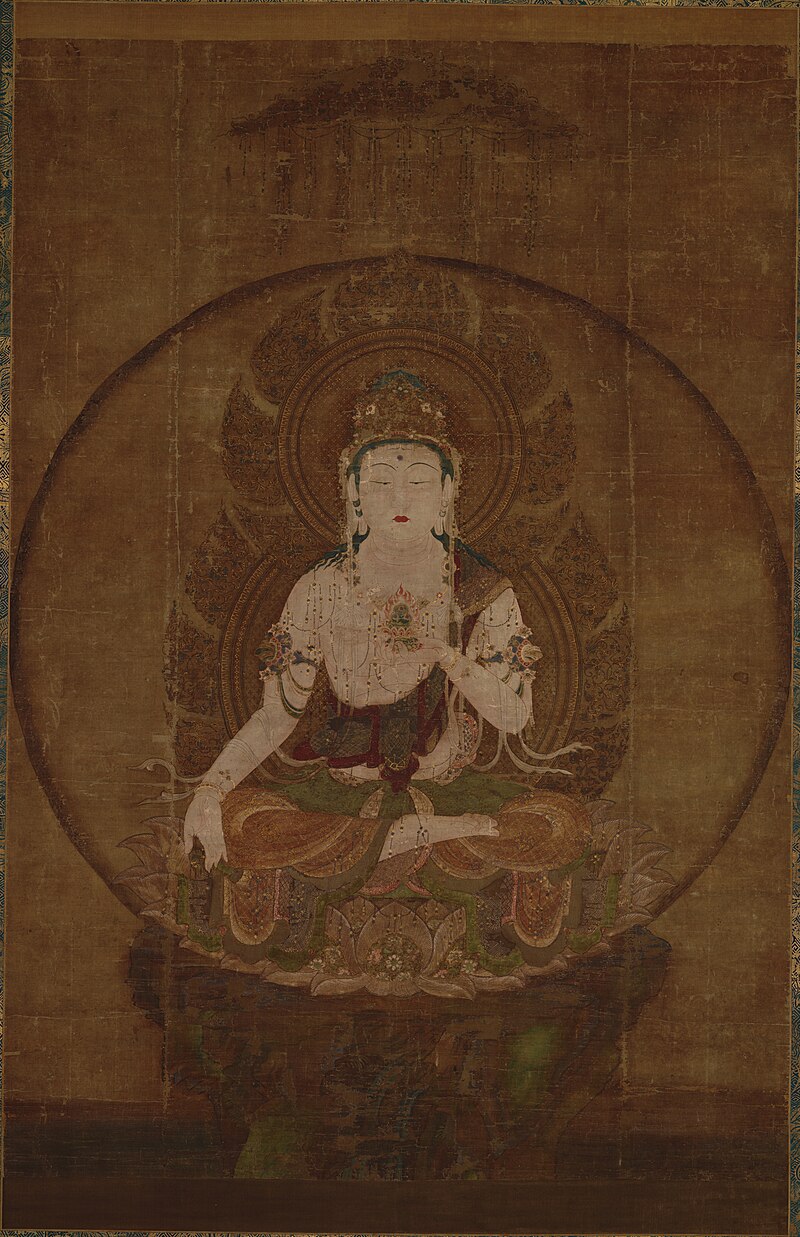
The answer is yes. And it has a name: 虚空蔵菩薩 Kokūzō Bosatsu — the bodhisattva of boundless space. In the Shingon tradition he is the keeper of inexhaustible knowledge and inexhaustible compassion. His name carries the key: 虚空 Kokū means "empty space", "ether" — exactly what Sanskrit calls Ākāśa.
Ākāśa and Kokū — the same word 虚空
The Sanskrit word Ākāśa means "space" or "ether" — the fifth element, contained within all the others. It is the element that creates room so that the other four can exist. No space, no fire. No space, no water. Ākāśa is the ground of everything.
When the Buddhist texts came from India via China to Japan in the 8th century, Ākāśa was translated as 虚空 Kokū — "empty space". In the Shingon tradition this became the fifth of the Five Great Elements: 空 Kū, the space that contains and pervades all.
Kokūzō Bosatsu is the bodhisattva who embodies this space. His knowledge is "as boundless as space" — 虚空蔵 Kokūzō, literally: "storehouse of empty space". He is not the space itself. He is the one who grants access to the space — to the knowledge that lies within it.
Kūkai and the Gumonjihō 求聞持法
Kūkai — founder of the Shingon school — as a young man practised a ritual that changed his life: 求聞持法 Gumonjihō, the practice of "seeking knowledge through hearing and retaining". It is an intense ritual in which the practitioner recites the mantra of Kokūzō Bosatsu one million times — over weeks or months, in solitude, often on a mountain or on a cliff by the sea.
Kūkai described what happened to him during this practice: the morning star — Venus, in Japanese 明星 Myōjō — flew into his mouth. In that moment, Kūkai wrote, the boundless knowledge of Kokūzō Bosatsu opened to him. He could understand Sanskrit texts he had never seen. He remembered things he had never been told.
This experience was the turning point of Kūkai's life. It led him to China, where he received the full Shingon transmission. And it forms the background for what is called "access to the Akashic record" in the West — except that in the Shingon tradition there is no abstract "access", but a concrete practice with a concrete bodhisattva.
What the Akashic record really is 記録
In the Western esoteric understanding the Akashic record is often described as a kind of cosmic library — a place you "travel" to in order to "retrieve" information. That is a metaphor. And like every metaphor, it has its limits.
In the Shingon tradition, Ākāśa is not a place. It is a quality — the quality of boundless space that pervades everything. You do not travel there. You open yourself to it. The difference is fundamental: it is not about retrieving information, but about the capacity to open the mind so wide that knowledge can flow through.
Kokūzō Bosatsu in this tradition is not a librarian who hands you a book. He is the force that widens your mind — so wide that you can perceive what previously did not fit into your awareness. His practice does not develop "supernatural abilities" in the spectacular sense. It develops receptivity — the capacity to hear more, see more, understand more than the ordinary mind allows.
Kokūzō Bosatsu is an initiation in Shingon Reiki. On the Master Path and in deepening events there is the possibility of receiving a direct initiation into the force of Kokūzō Bosatsu. This initiation includes mantra, mudra and visualisation — the full Sanmitsu practice that opens access to this quality.
Kokūzō Bosatsu in practice 実践
Practice with Kokūzō Bosatsu begins with his mantra: Nōbō akyasha kyarabaya on arikya mari bori sowaka. This mantra has been recited in the Shingon tradition for over a thousand years — on Mount Kōya, in the temples of Kyoto and wherever practitioners seek wisdom and recall.
In daily practice you can recite the mantra before meditation — to widen the mind before going into stillness. You can use it before creative work — when you need access to insights that go beyond the rational. Or you can simply recite it as a daily practice and observe what shifts over weeks and months.
Many practitioners report, after the initiation into Kokūzō Bosatsu, a sense of expanded perception — not spectacular, but tangible. Dreams become more vivid. Intuition becomes sharper. Connections that were hidden suddenly become visible. Not because you have "gained" something. Because you have stopped closing yourself off.

Initiation into Kokūzō Bosatsu
In Shingon Reiki there is the possibility of receiving a direct initiation into the force of Kokūzō Bosatsu. Discover the path.
Discover your path Dainichi Nyorai