In the West, Kannon is barely known. Anyone interested in Buddhism may come across the name Avalokiteśvara or the Chinese form Guanyin. In Japan you meet this being on every corner — in cemeteries, in temples, on mountain peaks, by the roadside. Kannon is the bodhisattva who never stops listening. Whoever calls is answered. Unconditionally.
In Shingon Buddhism, Kannon holds a special place. This bodhisattva is not just a figure of devotion you ask for help. Kannon is part of the lineage through which Reiki flows. And Kannon is — as Kakuban described in the 12th century — the lotus in the heart of every sentient being.
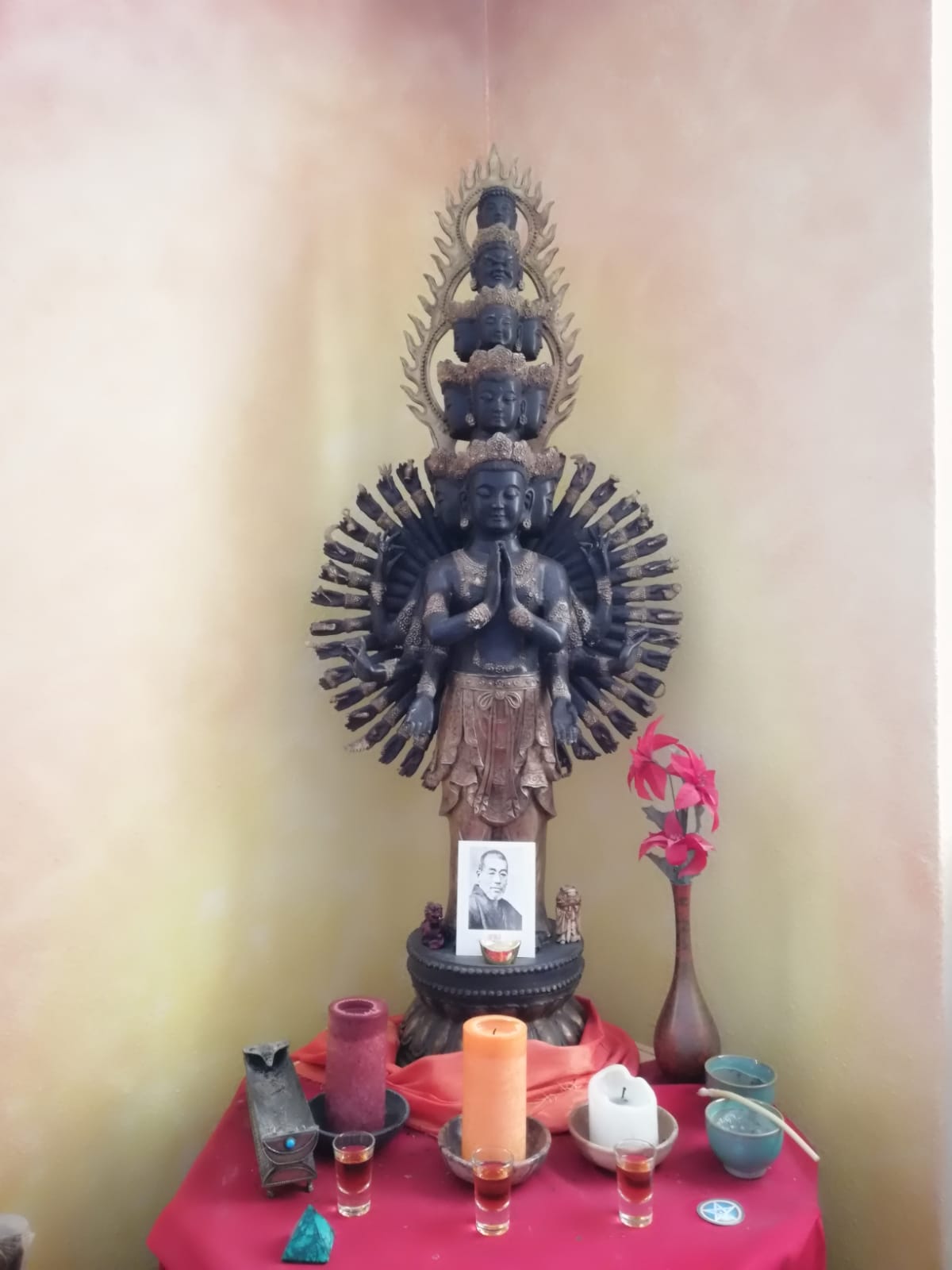
The name — what does Kannon mean? 観音
The full form is Kanzeon 観世音 — "the one who perceives the sounds of the world." The oldest Buddhist texts describe how this being hears all calls, simultaneously, everywhere. Not as a superhuman ability, but as the natural expression of boundless empathy. Kannon listens because Kannon cannot do otherwise. Compassion is not a decision — it is Kannon's nature.
The Sanskrit name is Avalokiteśvara — "the lord who looks down." In India, this being was originally male. As Buddhism moved to China and Japan, the depiction shifted. In Japan, Kannon appears in many forms — sometimes androgynous, sometimes female, sometimes with eleven heads or a thousand arms. The form changes. The compassion remains.
Kannon in the Shingon tradition 真言
In the Shingon school, Kannon is far more than an object of veneration. The bodhisattva stands in the lineage through which Shingon Reiki flows: Dainichi Nyorai — Senju Kannon — Yakushi Nyorai — Fudō Myōō — Kokūzō Bosatsu. Kannon is the second link in this chain — directly after the cosmic Buddha himself. That means: before the power of Dainichi Nyorai enters the world as Reiki, it flows through compassion.
This is no accident. In Shingon theology, compassion (jihi 慈悲) is not one quality among many — it is the channel through which cosmic energy can flow at all. No compassion, no transmission. No empathy, no Reiki. Kannon stands at this point in the lineage because compassion is the condition for everything that follows.
The Shingon reformer Kakuban (1095–1143) describes in his Ajikan writings the lotus in the heart as Kannon herself — the lotus of meditative absorption. Inherent in every sentient being from time without beginning. Not as outer help, but as inner nature. When you visualise the lotus in the heart in Ajikan meditation, you meet Kannon — within yourself.
The forms of appearance 変化
Kannon does not appear in one form. The bodhisattva takes the shape that the suffering being needs. The Shingon tradition venerates six main forms — one for each of the six realms of existence. Three are particularly important for practice.
Senju Kannon
千手観音A thousand hands, a thousand eyes. Each hand holds a tool of help. Each eye sees a being who suffers. In the great temples of Japan — Sanjūsangen-dō in Kyoto, Tōshōdai-ji in Nara — hundreds of Senju Kannon statues stand, embodying this boundless seeing and acting.
Jūichimen Kannon
十一面観音Eleven faces — three compassionate, three wrathful, three encouraging, one laughing and one as a Buddha. The eleven faces look in all directions at once. No one is overlooked. In the esoteric tradition this form works with the eleven levels of consciousness.
Nyoirin Kannon
如意輪観音The bodhisattva with the wish-fulfilling jewel (nyoi) and the wheel of dharma (rin). Six arms, seated in contemplation, chin resting on a hand — as if this being were just now considering your concern. In charge of the fulfilment of sincere wishes.
Shō Kannon
聖観音The simplest, purest form. Two hands, one lotus. Shō Kannon is the basic form — the bodhisattva without extra arms, without eleven heads, without cosmic equipment. Compassion only. Clear, direct, still.

Kannon in the mandala 曼荼羅
In the Taizōkai Mandala 胎蔵界曼荼羅 — the womb-world mandala of the Shingon tradition — Kannon has her own section: the Kannon division (Kannon-in 観音院). Right at the heart of the mandala, close to Dainichi Nyorai. The position shows what theology says: compassion is not a side issue — it is the heart of the cosmology.
In the ritual tradition the Kannon division is activated for protection, for accompanying the dying, for the opening of the heart. Whoever practises a Kannon meditation in a Shingon temple steps into this part of the mandala — not as imagination, but as ritual reality. The mudra is formed, the mantra recited, and for the duration of the practice the meditator becomes one with Kannon.
The mantra 真言
Kannon's most well-known mantra in Shingon Buddhism is the mantra of Senju Kannon:
Kiriku is the Japanese pronunciation of the Sanskrit Siddham Hrīḥ — Kannon's seed syllable. In Shingon practice this Siddham is visualised — golden, glowing, on a moon disc above a lotus. Whoever recites the mantra and at the same time sees the Siddham activates the Sanmitsu practice: body (mudra), speech (mantra), mind (visualisation). All three secrets work simultaneously.
There is another mantra better known in the West: Oṃ Maṇi Padme Hūṃ. It comes from the Tibetan tradition and refers to the same figure — Avalokiteśvara. In Japanese Shingon practice it is rarely used; here Kannon has her own, specifically Japanese mantras passed down within the lineage.
Kannon and Reiki 靈氣
What does a bodhisattva have to do with Reiki? More than most Western Reiki practitioners suspect. The Shingon Reiki lineage flows through Kannon — which means every initiation, every transmission, every session is permeated by Kannon's compassion. Not as a pious idea, but as energetic structure.
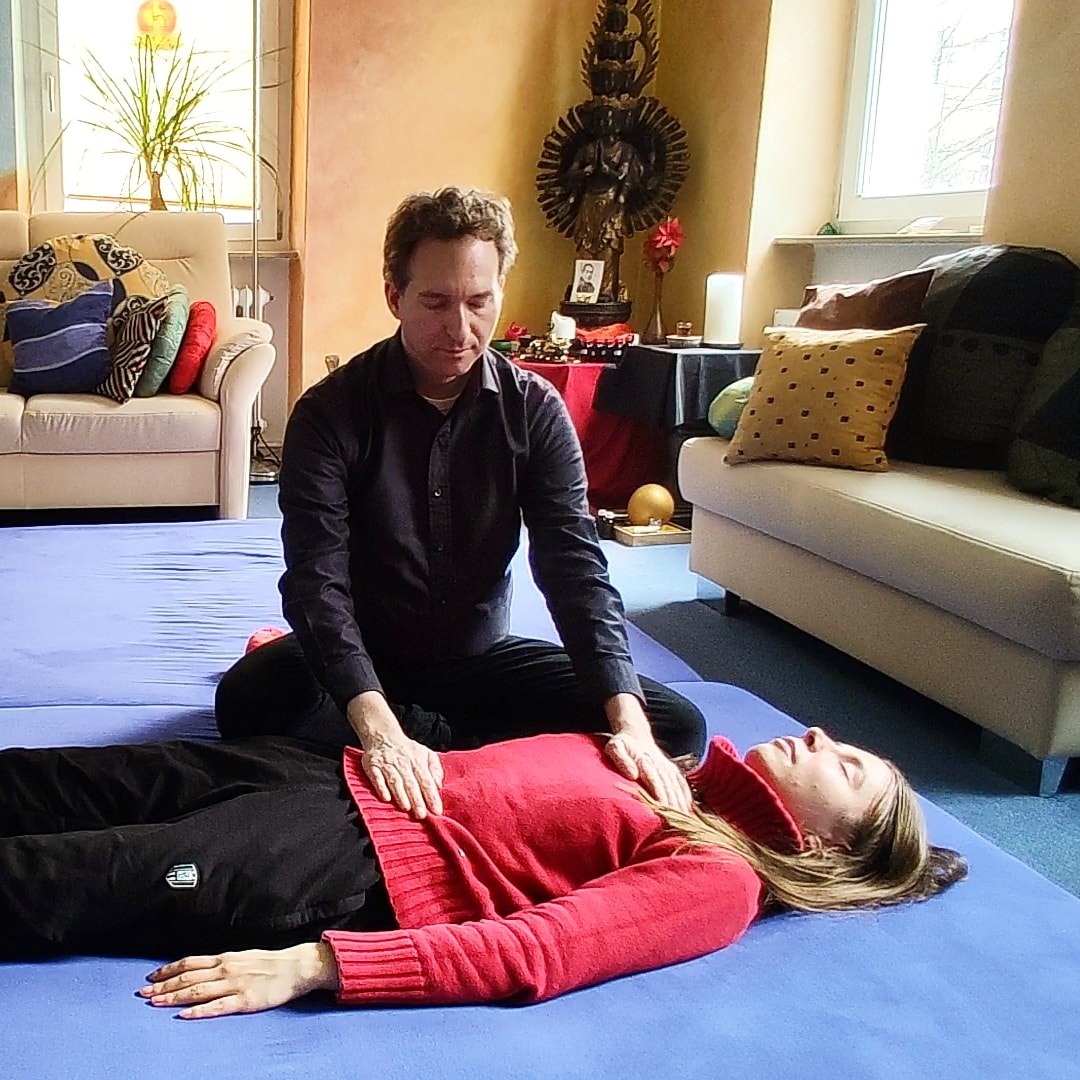
In practice this shows itself concretely: whoever gives Reiki listens. Not with the ears — with the hands, with the whole body. The hands sense where energy is blocked, where pain sits, where something wants to flow. This bodily listening is exactly what Kannon embodies: Kan — to perceive. On — the sound. The sound of hands on another person's body.
Giving Reiki is Kannon practice. Every time you lay on hands and perceive what the other person needs, you do what Kannon has been doing for aeons — listening, sensing, responding. The difference between someone who mechanically "applies" Reiki and someone who is really there is precisely this: compassion. The capacity to listen without saying a word.

The 33 temples — Kannon pilgrimage in Japan 巡礼
In Japan there are several Kannon pilgrim routes. The best known is the Saigoku Sanjūsansho 西国三十三所 — the pilgrimage to the 33 Kannon temples in western Japan. 33 temples, because according to the Lotus Sutra Kannon can appear in 33 different forms.
Mark Hosak has visited these temples — some during his three years of research in Kyoto, others on later journeys. In each of these temples stands a different form of Kannon: Senju Kannon in one, Jūichimen Kannon in the next, Nyoirin Kannon in a third. The diversity of forms tells a single story: compassion adapts to whoever needs it. It has no fixed shape — it takes the form that is right in this moment.
On the spiritual journeys to Japan that Mark and Eileen offer, Kannon temples are a fixed part of the route. Standing in front of a Kannon statue — not in a museum, but in a living temple where monks chant the sutra at four in the morning — changes the understanding of what compassion means. It is no longer a concept. It has a face. A thousand faces.
Migawari Kannon — the bodhisattva who takes your place 身代
One of the most touching forms of Kannon in Japan is Migawari Kannon 身代わり観音 — literally: "Kannon who takes your place." Legends across Japan tell of Kannon stepping in for a person in danger. A samurai sentenced to death finds, on the morning of his execution, a wounded Kannon statue in his cell. A woman trapped in a fire is carried out by an unknown being — the Kannon statue in the temple next door bears burn marks.
These stories are not naive miracle tales. They express something the Shingon tradition formulates with theological precision: Kannon is not a distant being. This bodhisattva is so close that the boundary between you and Kannon becomes permeable. In Ajikan meditation — when the lotus in the heart opens — that is exactly the experience: there is no longer any distance between the meditator and cosmic compassion.
Meet the tradition
Kannon is part of the lineage through which Shingon Reiki flows. Find out how you can meet this tradition — through initiation, through practice, on the journey to Japan.
Your path in Shingon Reiki Dainichi Nyorai