In Japan you sometimes see a stone figure by the roadside that looks unlike any other Buddha or bodhisattva: a being with a wrathful face and a horse's head on its crown. Travellers, riders and farmers have stopped in front of this figure for centuries — not to ask for enlightenment, but for protection of their animals. This is 馬頭観音 Batō Kannon — the manifestation of Kannon specifically connected to the animal world.
What does it mean when a spiritual tradition has its own bodhisattva for animals? It means the bond between human and animal is no side issue there. In the Shingon tradition, Batō Kannon has for over a thousand years been the force that carries Kannon's compassion into the animal world. And this very force is the foundation for what we today call animal communication with Shingon Reiki.

Who is Batō Kannon? 馬頭観音
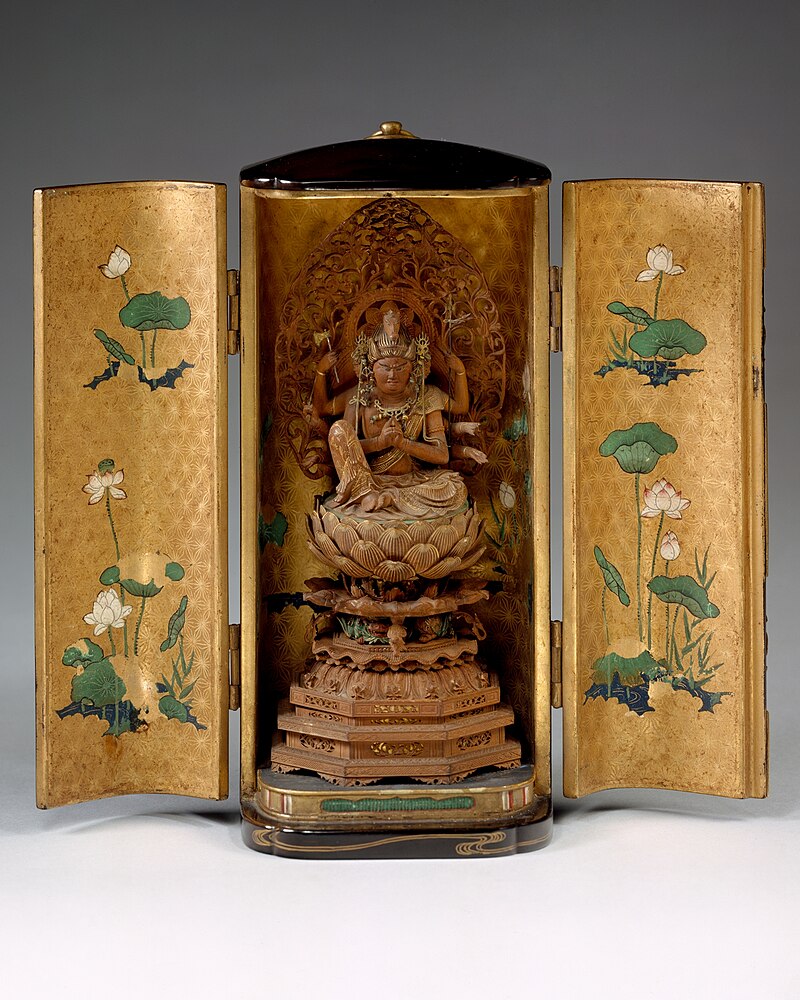
馬頭 Batō means "horse-head". 観音 Kannon is the bodhisattva of compassion — in Sanskrit Avalokiteśvara, the being who hears the cries of the world. Batō Kannon is one of his most powerful forms of appearance: not gentle and still like the ordinary Kannon depiction, but wrathful, wild and full of force.
This wrath is not anger. It is the force that breaks through obstacles — the same wrath that Myōō like Fudō Myōō embody. Batō Kannon belongs to the category of 明王 Myōō, the "wisdom kings", and is therefore sometimes also called Batō Kannon Myōō. He is the only Kannon who takes a wrathful form — because the animal world needs a different kind of compassion than the human world.
In Japan, Batō Kannon was for centuries the patron of horses — and with them all animals who live and work alongside humans. Along the old trade routes Batō Kannon stelae stand everywhere: at places where horses collapsed and died, at crossroads, on mountain passes. Farmers prayed to him for the well-being of their animals. And when an animal died, Batō Kannon was called to guide its consciousness into the next existence.
Reiki for animals — what really matters 動物靈氣
Giving animals Reiki is something fundamentally different from giving humans Reiki. Not because the energy would be different — but because the communication works differently. A human can tell you where it hurts. An animal shows you — if you look. And this is exactly where the actual practice begins: not with technique, but with empathy.
The most important rule when working with animals is so simple it almost sounds banal: observe what the animal wants. Not what you want. Not your plan, not your timeframe, not your idea of what a "session" should look like. The animal decides whether it wants to receive Reiki. It decides how close you may come. And it decides when it is over.
This attitude — deeply respectful, without agenda, without ego — is not just a good idea. It is the basic prerequisite. Animals immediately sense when someone arrives with an "I-need-to-make-something-happen-here" energy. Then they walk away. Or get nervous. Or bite. Not because they are ungrateful, but because a boundary is being crossed.
Reiki for animals needs empathy, flexibility and the willingness to let go of your own plan. A rigid "session" does not work with animals. What works is presence without expectation — hands ready, but no pressure. The animal comes when it is ready. And sometimes it does not come. Both are right.
Small animals, large animals, wild animals 生命
Depending on size and species the practice changes. A hamster, a small bird, a beetle — with these animals the whole body is smaller than the palm of your hand. There are no separate positions like with humans. You give Reiki to the whole being at once, simply by holding your hands gently around the animal — or, better still, with a little distance, so it does not feel constrained.
With medium-sized animals like cats and dogs you can reach individual body areas with your hands — similar to humans. With large animals like horses you need both hands for each area, because the body is so much larger than yours. It takes correspondingly longer, and the patience a horse demands of you is its own form of practice.
With wild animals — an injured bird on the balcony, a hedgehog in the garden — an additional rule applies: keep your distance. Reiki also works through the aura, that is, across distance. You do not have to touch a wild animal to reach it. And you should not try. Not because Reiki offers no protection, but because Reiki offers no protection against physical risks — bites, scratches, parasites. That is an important difference, sometimes forgotten in the excitement.
If an animal is clearly injured and needs medical care, then it needs a vet. Reiki does not replace veterinary care. It can support alongside it — but the priority is clear.
Batō Kannon in practice 実践
Initiation into Batō Kannon opens a specific connection: the ability to consciously carry Kannon's compassion into the animal world. That is more than just "giving Reiki to animals". It is its own path of practice with mantra, mudra and visualisation — the full Sanmitsu practice, the three secrets of body, speech and mind.
The mantra of Batō Kannon is: On amirito dōhanba un hatta sowaka. In daily practice you can recite it before meeting an animal — to activate your compassion and open your perception. You can repeat it in your mind during a Reiki session with an animal. And you can recite it when an animal is dying or has died — to lovingly accompany its consciousness.
Meditation with Batō Kannon begins in lotus posture or a comfortable seated position. You ask Batō Kannon for compassion and assistance. You visualise the bodhisattva's force flowing through you and out into the animal world. You feel how the boundary between "human here, animal there" dissolves — not because it does not exist, but because compassion permeates it.
Why the tradition matters 伝承
In the West "animal Reiki" is often offered as an extra — a nice add-on you pick up after the third weekend. In the Shingon tradition, working with animals is something else. It has its own history, its own bodhisattva, its own rituals. It is not an appendix. It is its own aspect of compassion.
That difference shows in practice. Whoever has only a technique — "hands on, Reiki flows" — quickly hits limits with animals. Whoever works with Batō Kannon, on the other hand, has a connection that goes beyond physical touch. The mantra opens a space. The visualisation creates a bridge. The initiation activates a force that has been alive in the lineage for over a thousand years.
Eileen Wiesmann has been working intensively with animals and Reiki for years — with her own pets as well as with other people's animals. Her experience confirms what the tradition shows: the connection with Batō Kannon does not only change the practice with animals. It changes the way you perceive animals — their needs, their emotions, their quiet communication that is so easily overheard.
What animal communication is not 注意
A few things should be clear. Reiki for animals is not veterinary care. It does not replace a visit to the vet, no vaccination, no emergency treatment. If an animal needs medical help, it needs medical help. Period.
Reiki for animals is also not a guarantee of any particular outcome. There are no promises about what will happen or not. What there is, is a practice that opens space for deeper connection, finer perception, more empathy. What the animal and you make of it is different every time.
And animal communication in the Shingon Reiki understanding is not a show. Not "I'll talk to your dog now and tell you what he is thinking". It is a quiet practice — soft, attentive, respectful. It happens in the space between human and animal, in the stillness that arises when you stop wanting and start perceiving.

Note: The practices described here do not replace veterinary care and are not a medical treatment. Reiki is a spiritual practice. Individual experiences may vary.
Initiation into Batō Kannon
On the Shingon Reiki Master Path there is the possibility of receiving a direct initiation into Batō Kannon. Discover the path to a deeper connection with the animal world.
Discover your path Kokūzō Bosatsu