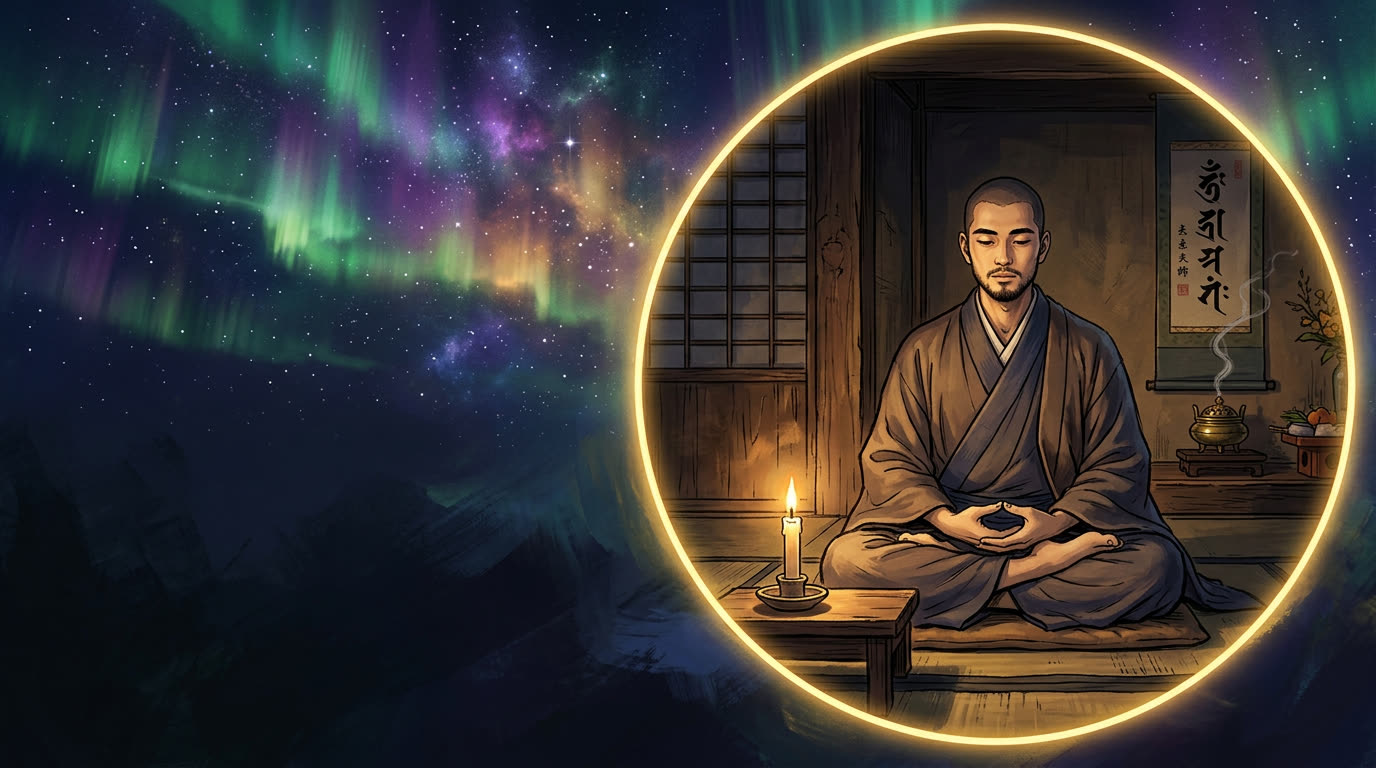
The Western Reiki world turned Mikao Usui into a legend. A Christian theologian. A gentle healer.
The truth is more interesting. He was a samurai descendant, a martial artist, a seeker —
and his path ran through the deepest esoteric traditions of Japan.
The man behind Reiki
Mikao Usui (1865–1926) · founder of ReikiUsui memorial stone · Saihoji Tokyo · the only contemporary source about his life
No gentle healer. A warrior on the path.
Mikao Usui (1865–1926) is the founder of Reiki. He was born into a family with samurai lineage, trained in the martial arts, traveled through Japan, China and Europe, and immersed himself in the esoteric traditions of his homeland — Shingon Buddhism, Tendai Buddhism, Shugendo and shamanic Daoism.
His decisive experience came on Mount Kurama, north of Kyoto. After 21 days of intense practice — fasting, meditation, water purification — he experienced a deep opening of consciousness. What he received there became the foundation of Reiki. Not as a soft relaxation method. As a path of spiritual development and the unfolding of supernatural abilities.
Looking skyward on Mount Kurama · where Usui meditated for 21 days
The memorial stone at Saihoji Temple in Tokyo, erected by his disciples, is the only contemporary source about his life. It tells a different story than the Western legend. A story of discipline, depth, and an uncompromising search for what is real.
Mark in conversation · decoding the memorial stone inscription
In Shingon Reiki, Usui's original intention is kept alive. Not the diluted version that traveled through Hawaii into the West. The thing Usui actually wanted: a path of inner and outer fullness. Of development. Of strength.
Going deeper
Usui and his legacy — article by article.
Each piece illuminates a different facet of the man who brought Reiki into the world.
The ascent of Mount Kurama · where Usui's awakening took place
Individual experience.
Every voice is a personal account. Results vary and depend on prior practice, openness,
life circumstances, and many other factors. Reiki and spiritual practice are not a
replacement for medical or psychological treatment.
“I am very glad I came across Mark Hosak's book. After that I decided to receive
the initiation into Reiki Level 1 with Mark Hosak in April 2005. Already back then
I was deeply impressed by the clarity and the intensity with which Mark guided the
practitioners on their path."
J. from Berlin
From the book to the path · since 2005
“I've been on the path with you for five years now, dear Mark. It took me a
little while to decide. First I experienced Reiki, then something shamanic, and
finally a monk weekend."
Mark at the Usui memorial stone · researching on site in Tokyo
Don't just learn about Usui's legacy. Live it.
In Mark's books you'll find the full research on Usui's life and his intention.
And on the Shingon Reiki path you experience what Usui actually wanted: a path of strength, of development, of inner fullness.
Gokai · Usui's Life Principles · calligraphy by Mark
FAQ
Who was Mikao Usui?▸
Mikao Usui (1865–1926) was the founder of Reiki. He came from a samurai family, immersed himself in the esoteric traditions of Japan — including Shingon Buddhism, Tendai Buddhism and Shugendo — and had his decisive spiritual awakening on Mount Kurama near Kyoto. He was not a Christian theologian, as the Western legend claims.
What is the Usui memorial stone inscription?▸
The memorial stone for Mikao Usui stands at Saihoji Temple in Tokyo. It was erected by his disciples and contains the only contemporary source about his life. The inscription describes his samurai background, his studies of the esoteric traditions and his awakening on Mount Kurama.
What are the Usui Life Principles?▸
The Usui Life Principles (Gokai) are five lines that Mikao Usui passed on to his practitioners: On this very day today, do not be angry. Do not worry. Be grateful. Devote yourself to your karma. Be benevolent to all living beings. These lines are rooted in the Meiji era and weave Shinto and Buddhist values into one practice.
Where did Mikao Usui have his awakening?▸
Mikao Usui had his decisive awakening in 1922 on Mount Kurama, a sacred mountain north of Kyoto. After 21 days of fasting, meditation and water purification, he experienced a deep opening of consciousness that became the foundation of Reiki. Mount Kurama is a place where Shugendo, Tendai Buddhism and shamanic Daoism converge.
Did Dr. Mark Hosak research Usui's sources directly?▸
Yes. Mark Hosak completed his doctorate at Heidelberg University on the origins of Reiki and Kuji Kiri, translating Japanese and Chinese primary texts. He has visited the Usui family temple in Taniai (Usui's birthplace), studied the memorial stone inscription at Saihoji in Tokyo, and practiced for years in Shingon, Tendai and Zen temples in Japan. The research feeds directly into how Shingon Reiki is taught and lived today.
Go deeper
Read on about Mikao Usui.
Who Usui actually was can't be said in one sentence. Here are the pieces that show him from different angles.
PhD in Japanese Studies · researcher and practitioner of the Shingon tradition · founder of Shingon Reiki
Mark Hosak earned his doctorate at Heidelberg University on the origins of Reiki and Kuji Kiri, practiced for three years in the temples of Kyoto, and walked all 88 temples of the Shikoku Pilgrimage. He has visited the Usui family temple in Taniai. He is the author of the bestselling The Big Book of Reiki Symbols and a master of Shingon Reiki for over 25 years.