Qigong and Reiki. For most people in the West these are two completely different things. Qigong — Chinese energy work with flowing movements in the park. Reiki — laying on of hands on a treatment table. Different countries, different methods, different worlds. Or so it seems.
But what if this separation is an illusion? What if Reiki and Qigong are not just related but spring from the same source? What if the founder of Reiki was regarded as a Qigong master in his homeland — and the West simply forgot the connection?
A Japanese Qigong reference book describes Mikao Usui as "one of the greatest Japanese Qigong masters of the 20th century" — as someone who "founded his own Qigong style with Reiki." That sentence changes everything. It shows: in Japan, the link between Qigong and Reiki was never a secret. It was simply lost on the way to the West.

Ki and Qi — same character, different readings 氣
That is not interpretation. That is character study. Anyone reading the character 氣 sees within it the character for rice — 米 — wrapped in rising steam. Life force rising from food. Breath that pervades the body. A force you cannot see, but can feel.
In China this force is called Qi. In Japan it is called Ki. In India it is called prana. The name changes with the language. The experience remains the same. And the methods of working with this force have been refined in East Asia for thousands of years — in the tradition we now call Qigong.
Usui's sources — Shingon, Daoism, Shinto 源流
Mikao Usui was no esotericist in the Western sense. He was a practitioner deeply rooted in the spiritual traditions of Japan. His background included Shingon Buddhism — the esoteric Buddhist school Kukai brought from China to Japan in the 9th century. He practiced methods from Daoism, the foundation of Qigong, Feng Shui and Traditional Chinese Medicine. And he was familiar with Shinto, the indigenous spiritual tradition of Japan.
All these traditions work with the same force — 氣. In Shingon Buddhism it is activated through mantra, mudra and meditation. In Daoism through breath work, movement and inner alchemy. In Shinto through purification rituals and the connection with the Kami. Usui knew all these paths. And Reiki — his Reiki — was no reduction to laying on of hands. It was a synthesis. An integrated practice of energy work that joined meditation, breath work, mantras and hand positions.
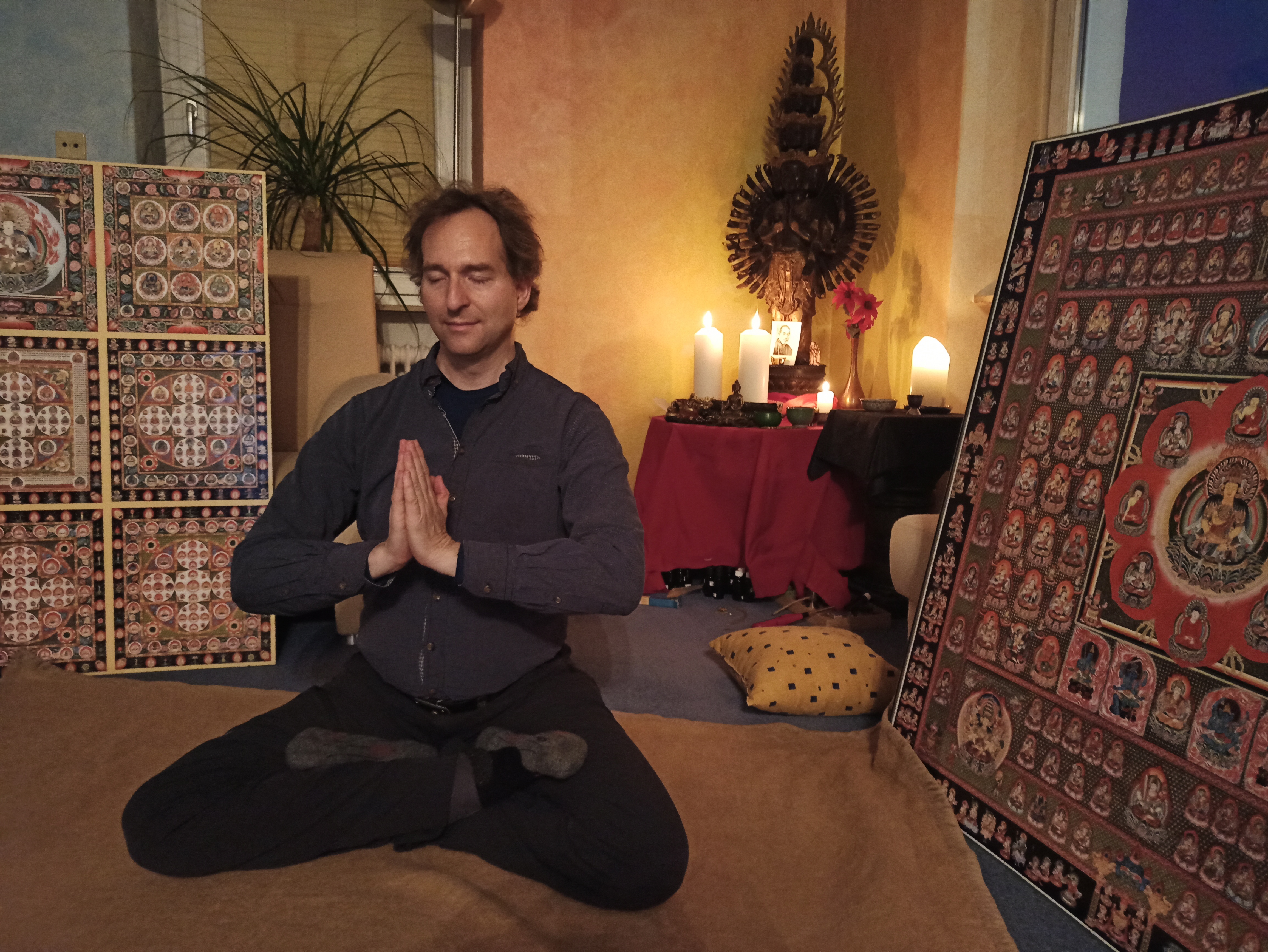
Anyone who looks at Usui's practice as a whole recognises the Qigong elements at once: the Jōshin Kokyū Hō — a breath practice that gathers energy in the Hara, the centre of force below the navel. The Hatsurei Hō — a meditation technique to activate spiritual force. The work with the Tanden, the energetic centre of gravity. All these are classical Qigong principles — carried into a Japanese context.
What was lost on the way to the West 西洋
When Reiki arrived in the West via Hawaii after the Second World War, something decisive happened: the practice was simplified. The meditative foundations — breath work, gathering energy in the Hara, the contemplative connection to the mantras — were gradually removed. What remained were the hand positions. Laying on of hands as a technique, detached from the meditative practice underneath.
That was understandable. Western practitioners had no access to the Japanese, Chinese and Sanskrit sources. They knew neither Shingon Buddhism nor Daoism from their own experience. So they passed on what they understood: the hand positions, the symbols, the initiation rituals. The energetic and meditative depth — the Qigong inside Reiki — was lost.
The result is what most people understand as Reiki today: a gentle method of laying on of hands that produces relaxation and wellbeing. That is not wrong. But it is only the surface. It is as if you knew an ocean only by its waves — without sensing what lies beneath.
Reiki was diluted in the West because its Qigong elements were passed on as mere techniques — without the meditative and energetic foundation that gives them power. The hand positions without the breath work. The symbols without the contemplative practice. The form without the content.
Shingon Reiki — restoring the connection 真言靈氣
Shingon Reiki goes the other way. Instead of simplifying Reiki further, it restores the original depth. The Qigong elements — breath work, gathering energy in the Hara, meditative absorption — are integral to the practice. Not as an extra. Not as an optional add-on. As the foundation everything else stands on.
In practice this means: before the hands are placed, there is meditation. Before energy flows, it is gathered. Before a symbol is drawn, the inner connection is created through mantra and mudra. In Shingon Reiki, Qigong and Reiki are not separate disciplines — they are aspects of the same practice. As it was with Usui.
Mark Hosak did not invent this connection. He found it in the sources — in Japanese and Chinese texts, in the writings of Shingon Buddhism, in the living practice of the temples he visited during his three years of research in Japan. The connection between Qigong and Reiki was always there. It only had to be rediscovered.
Anyone who practices Shingon Reiki feels this difference. The hands are not simply placed — they become channels of a force prepared through breath, meditation and intention. The symbols are not abstract signs — they are alive because they are anchored in meditative practice. And the body is not only a receiver — it is actively engaged, a resonance space for life energy.

For anyone already familiar with Reiki or Qigong, Shingon Reiki opens a new perspective. The seemingly separate paths lead to the same summit. And whoever knows both sides of the mountain understands the mountain better than someone who has only seen one side.
Anyone who wants to go deeper into the link between breath and energy will find more in the article on Qigong breathing in Reiki practice. And anyone who wants to understand what Shingon Reiki is at its core begins best with the overview of Shingon Reiki.
Experience the full practice
Reiki with the depth of Qigong, meditation and mantra — as it was meant to be. Find the entry point that fits you.
Your Path in Shingon Reiki Discover Chanmi Qigong