Imagine you lie down, close your eyes — and begin to walk through your body from the soles of your feet to the crown. Not with your hands. With your attention. Each zone, each joint, each layer receives a moment of full presence. That is the bodyscan meditation. And what sounds simple at first opens a doorway many do not expect.
In the West the bodyscan became known mainly through Jon Kabat-Zinn and his MBSR program (Mindfulness-Based Stress Reduction) — as a mindfulness exercise that lowers stress and restores contact with one's own body. Yet the roots reach deeper. A systematic walk through the body with attention is found in the Vipassana tradition, in Zen, in Hatha Yoga — and in Chanmi Qigong practice, where it gains its own quality as the "Inner Smile." Related techniques in the Reiki tradition also let the body be experienced as an energetic landscape.
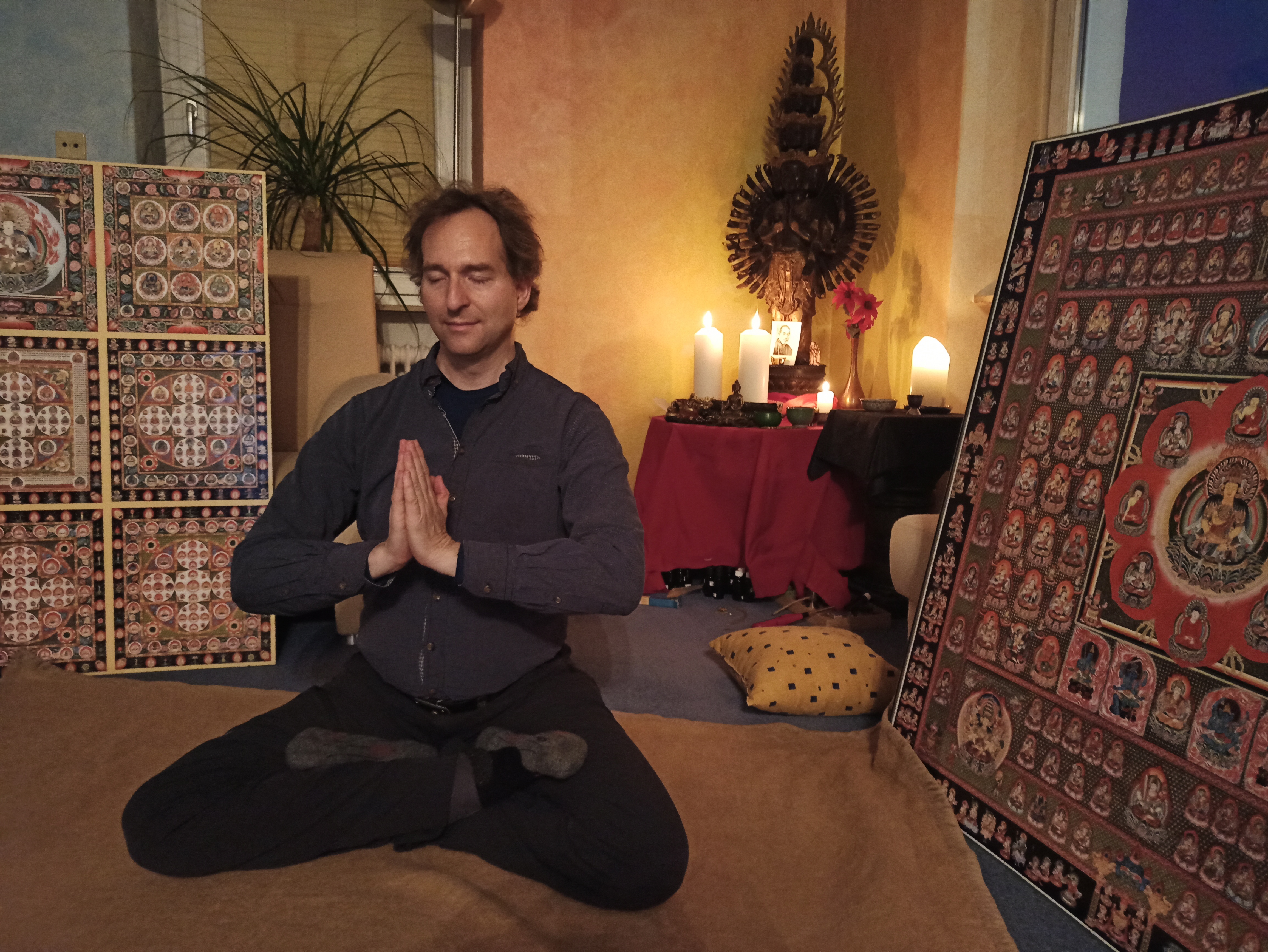
What happens during the bodyscan? 身体
At its core the bodyscan is a guided journey through your own body. You lie down or sit in a comfortable meditation posture and direct your attention systematically to individual body areas — beginning at the feet, through the legs, the trunk, the arms up to the crown. Each zone receives between 30 seconds and several minutes of attention. A full session typically takes 20 to 45 minutes.
What happens is more than relaxation. You begin to feel your body from the inside — not as an abstract concept, but as a living landscape. Here a pulsing. There a warmth. In some places emptiness or numbness. In others a surprising aliveness you never noticed in everyday life. The bodyscan turns the body back into what it actually is: a resonance space, an instrument of perception.
In the mindfulness tradition the point is not to change anything. The instruction is: notice what is there, without judging. Pain is allowed to be pain. Tension is allowed to be tension. Just non-judgemental observing changes the relationship with the body — and tensions often release on their own when attention gives them space.
The Inner Smile — joy as practice 微笑
In Chanmi Qigong there is a practice that lifts the bodyscan into another dimension: the "Inner Smile." Instead of merely observing the body neutrally, you let it be permeated by a quality — by joy. You smile at your organs. You smile at your joints. You send an inner smile through every fibre, from inside outwards.
That sounds unusual. And that is exactly the point. Most people have a relationship with their body shaped by criticism — too heavy, too tired, too painful. The Inner Smile turns this dynamic around. It is not an affirmation, no "I am beautiful as I am." It is more direct: a warm, friendly noticing that does not judge the body but greets it. The way you would greet an old friend you have not seen for a long time.
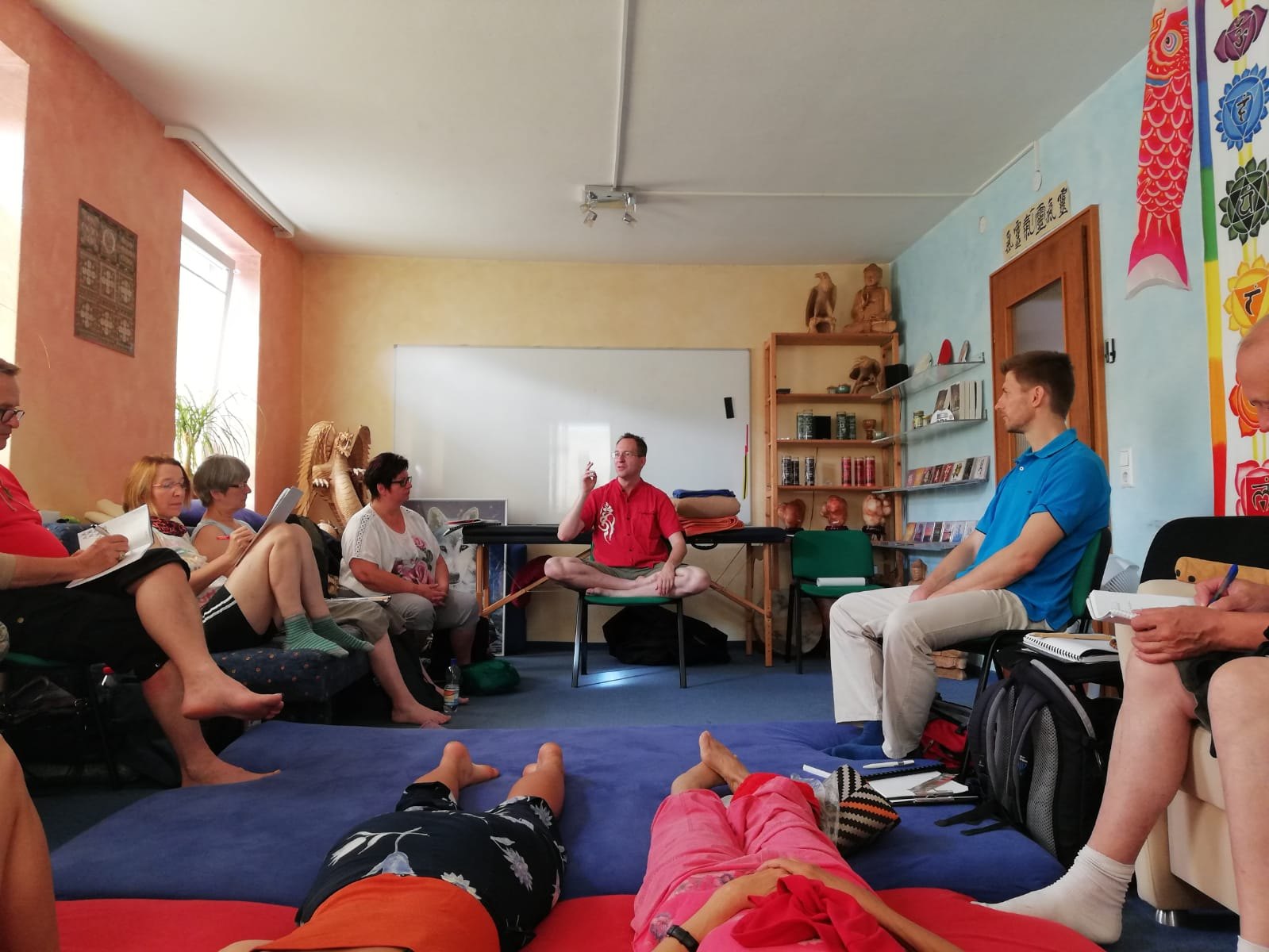
The link to the bodyscan is clear: when you walk systematically through the body and touch every zone with this inner smile, something arises that is neither pure mindfulness bodyscan nor pure Qigong. It is a practice that joins attention and heart-quality — and finds its counterpart in the Reiki tradition.
In Shingon Reiki the body is not only observed — it is experienced as an energetic landscape. The hands on the body, the attention in each zone, the sensing of warmth and pulsing: these are the same basic principles as in the bodyscan. The difference lies in the depth of connection — and in the transmission lineage that has carried this practice for centuries.
Bodyscan and Reiki — kindred paths 靈氣
Anyone who practices Reiki knows the principle: the hands are placed on certain body positions, and the attention turns to what is happening under the hands. Warmth, pulsing, tingling, coolness — the body answers. In Shingon Reiki the work with breath, mantra and inner image joins this. The hands do not simply rest on the body — they open a gate.
The bodyscan is, in a sense, the foundation for this perception. Anyone who has never learned to feel their own body from the inside will perceive less in a Reiki session as well. Conversely, regular bodyscans deepen the ability to feel energy in the body — your own and that of another person's hands. The two practices are not rivals. They complete each other.
And one more thing connects them: relaxation meditation is often about letting go, coming to rest. That is valuable. But both bodyscan and Shingon Reiki are about more — about an awakening within the body. Not relaxation as the end goal, but relaxation as the foundation for deeper perception.
Obstacles — and how to meet them 道
Anyone who practices the bodyscan meets certain obstacles. They are not signs of failure — they are part of the path. The most common ones:
Falling asleep. The classic. You lie comfortably, close your eyes, relax — and wake up twenty minutes later. This happens especially at the beginning and shows how exhausted the body actually is. The fix is not to fight it, but to adjust the practice: practice sitting, leave the eyes slightly open, or move the practice to a time of day when you are more awake.
Wandering thoughts. Attention is supposed to be at the left foot — but you are planning dinner. That is no problem. That is the moment when the actual practice begins: you notice that attention has wandered, and bring it gently back. This noticing is the practice. Not perfect concentration.
Pain or unpleasant sensations. Some body areas speak up with pain, pressure or discomfort. The mindfulness tradition advises: do not run away, but do not amplify it either. Observe the pain as if you saw it for the first time. Often it changes through attention alone — softens, moves, dissolves. If pain becomes too intense, it is fine to move attention onward.
Numbness or not-feeling. There are body areas where you initially perceive nothing — no sensation, no signal. That too is information. The bodyscan reopens these numb zones, layer by layer, session by session. Patience is the key here.
Lack of time. 45 minutes are not always possible in everyday life. But even a bodyscan of ten minutes — in the morning after waking or in the evening before sleep — changes body perception. It does not need to be perfect. It needs to be regular.

The bodyscan is one of the most accessible ways to refine perception of your own body. It needs no prior knowledge, no initiation, no special equipment. And at the same time it prepares the ground for everything that goes deeper — for energy work, for the Inner Smile, for the encounter with your own body as the living mandala it is. Whoever can feel what is happening within is ready for the next step.
Your path into depth
The bodyscan is the beginning. Shingon Reiki carries on — with energy work, mantra and a living transmission lineage. Find the entry point that fits you.
Your Path in Shingon Reiki Relaxation Meditation